
Conewago Valley proposes $62.3 million personnel budget, adds positions for special education, technology and maintenance
Get AI-powered insights, summaries, and transcripts
Subscribe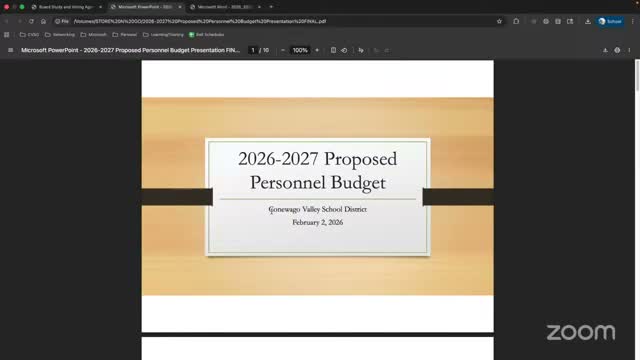
Summary
Business manager Scott Fraser told the board the proposed 2026–27 personnel budget is $62,325,977 (up $3,595,638). The plan includes taking back 12 autistic‑support positions from the IU, 10 new staff roles (director of innovation, counselors, college/career coordinator, middle‑school Spanish teacher, maintenance and security positions), and anticipates higher pension and insurance costs.
The Conewago Valley School District presented a proposed personnel budget of $62,325,977 for 2026–27, an increase of $3,595,638 over the prior year, business manager Scott Fraser told the board during a Feb. 2 personnel committee meeting. "This personnel budget is proposed at $62,325,977," Fraser said.
Fraser said roughly 84% of personnel expenses are tied to instruction (teachers, librarians and aides) and about 16% fund building administration, district office, security and maintenance. He said roughly half of personnel spending was budgeted for salaries and about 43% for benefits, a split Fraser said is in line with other Pennsylvania districts given pension and health‑cost pressures.
A notable element of the proposal is a district 'takeback' of 12 autistic‑support positions that the Lincoln IU previously operated. Fraser described that set of positions as four teachers and eight aides and estimated a worst‑case additional personnel expense of $1,165,909 if all hires were made at top‑scale with family benefits; he said in‑district placements could be less costly per student than paying the IU.
The staffing plan also lists 10 additional positions the district would like to add, including a director of innovation, an assistant maintenance/fleet director, a college/career coordinator, two new school counselors for elementary grades, a CTE counselor, two math interventionists/aides, a middle‑school Spanish teacher, a school security officer for CTE, and a maintenance worker. Fraser said job‑line spreadsheets in the board packet show high and low cost scenarios and that most new hires were costed at a 'worst‑case' top‑of‑scale level to avoid underestimating liabilities.
On benefits, Fraser said about 85% of benefit costs are for medical insurance and PCERS, the state pension system, and that PCERS rates are set by the state (he cited approximately a 33.59% employer contribution). "Our medical insurance went up 11.9%," he said, and noted the district contributes to HSAs as part of bargaining agreements (he cited $2,145 per family plan and $1,072.50 per single plan).
Superintendent Dr. Perry framed the proposed director of innovation as a curricular‑technology leader who would focus on rostering, app management and ensuring instructional alignment across K–12; the technology department would continue to manage hardware and infrastructure.
Board members asked for follow‑up numbers on salary ranges, recruiting competitiveness and clarifications about which positions fall under collective‑bargaining scales. Fraser said he would provide more detailed salary breakdowns on request and reiterated that the memo and attachments include both conservative (high‑cost) and low‑cost scenarios.
Next steps: the board agreed to continue personnel and budget discussions at the committee of the whole meeting on Feb. 17, and staff said hiring and exact salary placements would be decided later if and when positions are approved.