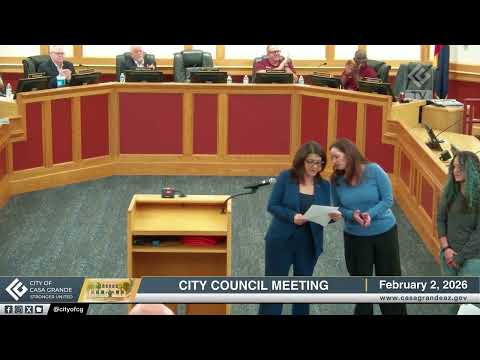
Casa Grande council grants conditional use permit to KPPC Advanced Chemicals after safety and routing debate
Loading...
Summary
After extended testimony and technical presentations, the City Council voted unanimously to grant KPPC Advanced Chemicals a conditional use permit to build a chemical-manufacturing facility in a Casa Grande industrial zone, following staff review, applicant safety assurances and discussion of truck routing.
Casa Grande — The City Council voted to grant a conditional use permit to KPPC Advanced Chemicals for a chemical-manufacturing facility on approximately 26 acres in the city’s I-2 industrial zone, adopting Resolution No. 5884 after public testimony and detailed presentations by planning staff and the applicant.
The council’s decision followed a staff overview of permits and review criteria and a lengthy applicant presentation by Austin Lu, general manager of KPPC Advanced Chemicals, and Beau Dromiak of WMA Architects. Planning staff had described phase 1 as a 6-acre facility for purification and blending of semiconductor-grade chemicals including hydrochloric acid and ammonium hydroxide, and said the project must secure federal, state and local permits including EPA/RCRA registration, county air-quality permitting and a comprehensive fire permit.
Why it mattered: Council members focused their questions on truck routing, emergency response and whether the use fits the city’s adopted land-use map. Planning staff emphasized the site’s industrial designation and said the parcel’s size and setbacks are adequate. The applicant’s representatives said the operation uses internationally standardized ISO containers and double-containment systems and that they have coordinated safety procedures with the Casa Grande Fire Department.
“Safety without limits isn’t safety. It’s surveillance,” resident Jacob Petroski said earlier in the public comment period while raising concerns about local surveillance data; Petroski’s remarks were unrelated to the technical safety evidence the applicant presented but underscored public anxiety about oversight and data transparency.
Applicant assurances: Austin Lu told the council the company intends to establish long-term local operations and invest in the community. "We are excited about establishing a long term operation in Casa Grande," Lu said, adding that KPPC will require trained, certified drivers and contracts with carriers to follow recommended routes. Beau Dromiak explained the mechanical and inspection features of ISO containers and said the company prefers the I‑8 route for deliveries because it is less dense and thus lower risk.
Fire-department coordination: Applicant representatives said the Casa Grande Fire Department reviewed the plans and supports the project’s emergency-response approach. "The fire department has confirmed that the local emergency response responders are fully capable of handling these materials," an applicant representative said during the presentation.
Council discussion and vote: Council members asked whether a preferred route could be written into a CUP and were cautioned by staff that imposing a specific hazardous‑materials route is legally and practically difficult to enforce; staff and the applicant said they would pursue contractual routing commitments with carriers and work on alternative bypass routes for Pinal Avenue. After deliberation, a council member moved to approve Resolution No. 5884 granting the CUP. The motion was seconded and carried on a roll-call vote; all members present voted Yes.
What happens next: With the council’s approval the applicant may proceed to the next phases of design and permit applications with the understanding that they must obtain required permits (air, wastewater, building and fire) before commencing regulated operations. The council then moved into executive session to seek legal advice on other matters.
— End —