Get Full Government Meeting Transcripts, Videos, & Alerts Forever!
Get email alerts on the Water Supply topic
No spam. Unsubscribe anytime.
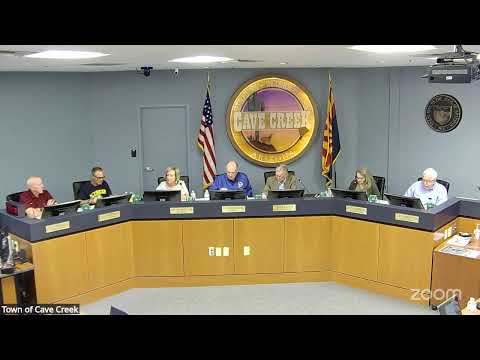
Cave Creek council authorizes $100,000 earnest payment to pursue Harquahala groundwater allocation
Summary
Facing anticipated Colorado River/CAP cuts, Cave Creek approved a $100,000 earnest payment to reserve a 500‑acre‑foot allocation from the Harquahala Valley project, with the town retaining a due‑diligence window to back out. Council voted 5–2 after hours of staff briefings and public comment.
Cave Creek officials on Tuesday authorized the town manager to deposit $100,000 in earnest money to reserve a 500‑acre‑foot allocation of groundwater rights from the Harquahala Valley project, a purchase staff says could help the town replace a portion of its Central Arizona Project supply if future CAP reductions occur.
Utilities director Sean Cruz Wisener told council that the town relies on CAP for roughly 90 percent of its municipal and industrial supply and that state and federal negotiations could deliver a planning‑level 25 percent cut to CAP allocations by January 2027. He said the Harquahala project offers a groundwater allocation that ADWR modeling shows could meet the 100‑year assured water supply requirement if the town purchases an allocation and secures necessary permits and conveyance arrangements. “By 2027, we’re gonna be in… a shortage situation,” Cruz Wisener said during his presentation.
Staff described a multi‑step acquisition: an immediate $100,000 earnest payment to secure a lot that carries groundwater rights, with a requested total purchase price of $11,200,000 for the first tranche. The town would still need ADWR approval to import the water and a wheeling agreement with CAP to move the water into the delivery system; staff estimated physical infrastructure could require three to five years to complete. Staff also noted ongoing water‑banking, possible reactivation of local wells and use of storage credits as short‑term bridges.
Council questions focused on the funding source for the earnest payment and the unknown additional costs for pumping, treatment and conveyance. Staff said the $100,000 would come from the utilities department’s operating budget and would not affect transfers. Town counsel and the water policy adviser outlined legal and regulatory steps, including potential NEPA review by the Bureau of Reclamation, and warned of timing and cost uncertainty.
Public commenters urged caution. Resident David Phelps warned of legal and environmental risks tied to agricultural uses on project lands and called the purchase “paper water.” Other council members framed the vote as buying time for due diligence: Council member Cynthia said approving the earnest payment “buys us some time” to gather more information; Council member Dusty (Rhodes) dissented, saying the town lacked full cost estimates and arguing the purchase could be rushed.
Council member Tom moved the authorization. In a roll call vote (Olgerton No; Driscoll Yes; Friedman Yes; McGuire Yes; Rhodes No; Vice Mayor Royer Yes; Mayor Morris Yes), the motion carried 5–2.
Staff will proceed with due diligence through the contract window and may withdraw and seek refund of the earnest money if outstanding issues are unacceptable. The council did not authorize the full purchase amount; that step would require additional review and future council action.
Ending: The council’s authorization secures the town a seat at project discussions and a short window to complete technical, legal and financial due diligence before committing to the full acquisition.