Get Full Government Meeting Transcripts, Videos, & Alerts Forever!
Get email alerts on the Climate Modeling topic
No spam. Unsubscribe anytime.
Littleton advisory board backs 'moderately aggressive' climate target, urges 100% energy-efficient streetlights
Summary
At a board meeting, ICLE USA presented ClearPath2 modeling showing 69–79% potential emissions reductions by 2050; the board voted to recommend a moderately aggressive overall target to City Council while asking the city to pursue 100% energy-efficient street lighting.
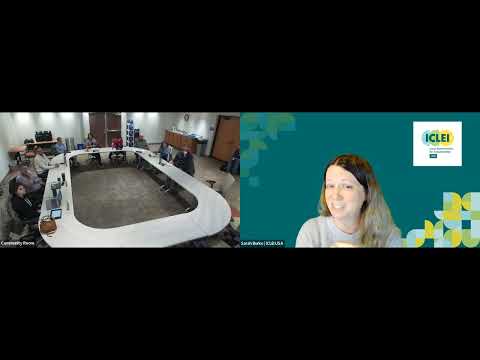
Sarah Burke, a consultant with ICLE USA, told Littleton’s Environmental Stewardship Board that ClearPath2 modeling shows a range of plausible outcomes for the city’s greenhouse-gas emissions by 2050 depending on how aggressive the city’s building‑ and transportation‑sector interventions are. “If you follow everything that we’ve modeled tonight, and achieved all your actions, you would achieve a 79% reduction by 2050,” Burke said, characterizing that figure as the result of an aggressive, largely policy‑agnostic modeling run.
The consultant framed the modeling as a tool to translate Littleton’s 2023 greenhouse‑gas inventory into possible futures. Burke said stationary energy accounts for roughly 62% of the city’s emissions, transportation about 32% and waste about 6%, and that the model treats “activity shifts” — for example, square footage moving from gas furnaces to electric heat pumps — separately from the specific policies or number of charging stations that would drive those shifts.
The board’s discussion focused on how ambitious the advisory recommendation to City Council should be. Several members raised concerns about cost and equity, noting that reaching the most aggressive targets would likely require programs, incentives or capital beyond the city’s current budget. “If we set that goal of the most aggressive, we have to have an equally aggressive … incentive program,” one board member said during the exchange.
Public commenter Chadbourne pressed the board to restore a model lighting ordinance and to require lighting that protects neighbors from trespass and glare. “So let’s go a 100% for model lighting ordinance, into our zoning code,” he said, urging both safety and energy efficiency.
Board members weighed three modeled scenarios presented by ICLE USA: a most‑aggressive package (about a 79% reduction by 2050), a moderately aggressive package (roughly 74%) and a least‑aggressive scenario (about 69%). Members said staff could prepare program‑level analyses for Council on timing, likely costs and funding sources, but the board needed to choose what to recommend now.
After discussion, the board moved — and the group accepted by voice — a recommendation that Littleton present a moderately aggressive target to City Council while explicitly asking staff to pursue 100% energy‑efficient street lighting. The formal motion, offered by a board member during the meeting, read: “Motion that we do moderately aggressive, but go at a 100% for the street lights.” The transcript records the motion and the board’s vocal assent; no formal roll‑call vote was recorded in the meeting transcript.
Next steps noted in the meeting: staff will prepare the recommendation package for Council review (the consultant and staff signaled the intent to bring the item to Council for adoption) and to provide more detailed cost and program analyses as part of the implementation planning cycle.
Votes at a glance Motion: Recommend a moderately aggressive target overall; set street lights at 100% energy‑efficient. - Motion text: “Moderately aggressive overall; 100% for street lights.” - Mover: Board member (speaker 5). - Second: Not recorded in transcript. - Outcome: Approved by voice consensus (no roll‑call recorded).
Why it matters: The board’s recommendation will be forwarded to City Council as part of the city’s climate planning process; City Council will consider the recommendation alongside program‑level cost estimates and potential funding sources before any adoption or code changes.