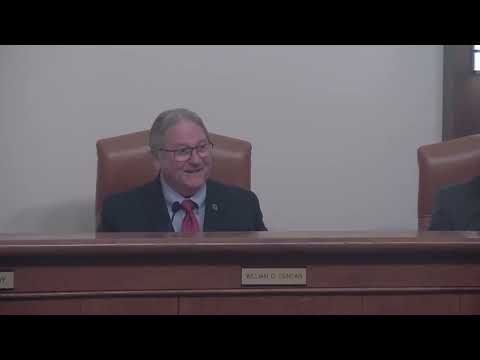
Mayor Duncan highlights public safety, staffing and long-term capital needs in 2026 State of the City
Loading...
Summary
Mayor Duncan used the State of the City to tout Oakwood’s public-safety response times, report $513,000 in expected forfeiture funds for equipment, outline 2026 strategic goals and warn of revenue pressure from proposals to eliminate real estate taxes.
Mayor Duncan delivered the 2026 State of the City to the Oakwood City Council on Feb. 2, stressing public safety performance, personnel transitions and a set of multiyear capital and planning priorities. He noted Oakwood’s population of 9,572 and said the city’s strengths include its neighborhoods, schools, library, parks and city services.
Duncan highlighted that Oakwood’s first-officer response time averages 2.2 minutes, engine response 4.2 minutes, and medic response 4 minutes, citing those measures as faster than national norms. He credited the city’s cross‑trained public safety department and singled out Detective Casey Ballinger’s work, announcing the city will receive about $513,000 in forfeiture/contraband proceeds in 2026 to fund public-safety equipment and capital improvements.
The mayor reviewed recent personnel changes: retirement of Municipal Court Judge Margaret Quinn and the election of Molly Tsitsinger to the judgeship; the 2024 retirement of the prior city manager and the council’s 2024 hiring of Katie Smitty as city manager; and multiple departmental retirements and internal promotions in 2025. He said Smitty has merged leisure services with public works and has focused on onboarding and operational improvements.
Duncan laid out council’s strategic goals for 2026: develop a 20‑year capital improvement plan; conduct a water cost‑of‑service study to examine longer‑term rate needs; continue compliance with the EPA lead service‑line requirements; revitalize Shafer and Orchardley parks; and expand business support through Montgomery County’s Business First program. He also said the city used reserves and targeted revenues last year to replace aging equipment, including planning for a replacement fire engine.
On finance, the mayor noted that only 8 cents of every property‑tax dollar paid by Oakwood residents goes to the city, with the remainder going to Oakwood Schools (73%), Montgomery County (17%) and Wright Library (2%). He reported the city received approximately $3.3 million in real‑estate tax revenue in 2025 and voiced concern about proposals to eliminate real‑estate taxes without a viable replacement revenue plan.
Why it matters: Duncan’s address combined operational metrics (response times, crime and EMS statistics), near‑term capital needs and policy priorities that will shape budget and planning work in 2026. The forfeiture funds and the planned capital‑planning work give council concrete items to consider during the upcoming budget cycle.
The council proceeded to visitors’ remarks and then to legislative business; the State of the City concluded with a brief question period and formal adjournment.