
Fairfax County hears HOA leaders' concerns about proposed Unified Sanitation Districts; cost, choice and small-hauler impacts dominate comments
Get AI-powered insights, summaries, and transcripts
Subscribe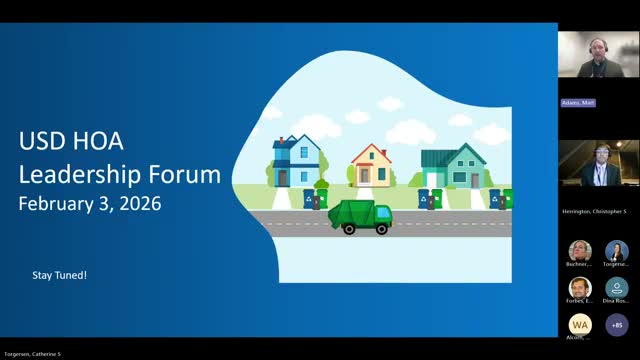
Summary
Fairfax County staff presented a Unified Sanitation District (USD) proposal and survey results at a listening session with HOA and civic-association leaders. Dozens of speakers urged clarity on costs, opt-out mechanics and protections for small haulers and seniors; staff reiterated a Virginia law 5-year waiting period and that no decision was made.
Fairfax County officials held a recorded listening session with homeowners association and civic-association leaders to gather feedback on a proposed Unified Sanitation District (USD) model for residential trash collection.
The county's presentation, led by Matthew Adams, Division Director for Solid Waste Management, outlined the USD concept as a county-administered, competitively procured contract for curbside single-family and townhome collection, with Fairfax County retaining customer-service responsibilities. Adams said the county lacks authority to limit private haulers or cap prices without a USD and noted that state law requires a five-year waiting period after a board vote before implementation.
The forum focused on survey results and public comment. Staff said an HOA-targeted survey (Jan. 5'26) produced 188 responses after exclusions and showed participation across HOA sizes and supervisor districts. Recurring themes included appreciation for competition and customized services under the current model, and concerns about transparency, price increases, loss of choice, procurement fairness and impacts on small haulers.
Many HOA leaders said they were satisfied with existing contracts and feared USD implementation would increase costs and reduce service customization. Jay Johnston, president of his HOA board, warned the plan would be "another tax on Fairfax County" and asked for guarantees on cost savings, twice-weekly or backdoor service where currently provided, and protections for small vendors. "This Unified Sanitation District is not the answer for Fairfax County," he said.
Others urged detail and data before the county moves forward. Cameron Adams of the Reston Association, which represents thousands of properties, urged the county to publish phase maps, eligibility rules for single-family and attached units, and clear guidance on whether service would be voluntary or mandatory within a designated USD area. He also suggested exploring use of existing special-tax-district surpluses to offset residents' costs.
Some attendees supported the county's study of USDs for neighborhoods lacking organized service, citing the potential for collective bargaining to reduce price disparities. But several speakers representing small HOAs and condominium associations said standardized canisters, fewer pickup days and larger trucks could be impractical because of private roads, narrow streets, multi‑story buildings and the needs of seniors.
Speakers repeatedly requested a clear opt-in/opt-out mechanism and a phased transition to avoid forcing communities to break long-term contracts or incur legal and administrative costs to amend governing documents. Several raised the risk that an extended five-year planning period could prompt small haulers to exit the market before a final county decision.
Questions about administration and cost also surfaced. Commenters asked who would pay for billing systems, software, call centers, additional county staff, and standardized carts. Lake Barcroft's president, representing a community already in a USD, said fees there rose 20'25% in two years and signaled that communities currently in USDs are watching price trends closely.
Legal and statutory constraints were raised. A speaker from Citizens for Great Falls cited state code language and argued the county must demonstrate statutory thresholds'for example, that private service is inadequate or a public nuisance'before displacing private haulers.
County staff and Supervisor Walter Alcorn said the Board of Supervisors has paused USD implementation to gather more public input. Staff closed the meeting saying no decision would be made at the forum, asked attendees to email further HOA-specific impacts or unresolved questions, and said the USD webpage will host the presentation, survey results and the recording.
The next procedural steps remain: staff will compile the feedback for the Board of Supervisors and update the USD website; any formal board action and statutory timelines would be separate and publicly noticed. The county emphasized the five-year waiting period required by Virginia law following a board vote before a USD could take effect.
Key takeaways: attendees want transparent cost modeling, a clearly defined opt-out or opt-in policy, protections for small haulers and senior residents, phase-by-phase implementation details, and assurance about how non-residential HOA assets and private roads would be handled.