Get Full Government Meeting Transcripts, Videos, & Alerts Forever!
Get email alerts on the School Safety topic
No spam. Unsubscribe anytime.
Brea Olinda counselors outline how parents can spot, report and respond to bullying
Summary
Brea Olinda Unified School District counselors defined bullying vs. conflict, outlined restorative practices and school investigation steps, and urged parents to document incidents, monitor devices, and use school reporting steps. They shared resources including a short upstander video.
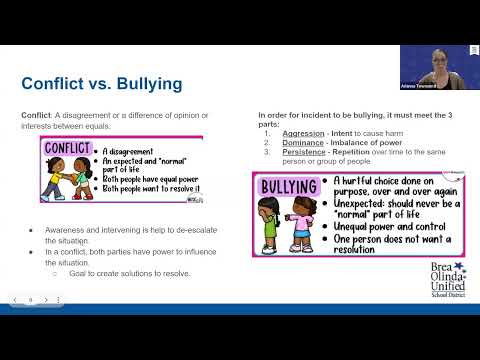
Brea Olinda Unified School District counselors told parents in a virtual training that bullying is defined by three concurrent elements — intentional harm, repetition and a power imbalance — and described how families can document and escalate concerns to school staff.
Dr. Alejandra Velez, the district’s administrative director of Special Education and Student Services, opened the session and said the training’s goals were to clarify definitions, teach proactive home strategies and explain how to escalate incidents to school officials. “Our objectives today are you as families will be able to understand the definition of bullying and harassment,” she said.
The counselors outlined concrete categories of bullying — verbal, physical, social (exclusion) and cyberbullying — and gave examples such as name-calling, threats, exclusion from groups and publishing private information online. Arianna Townsend, Country Hills elementary counselor, said all three criteria must be present to classify an incident as bullying: “It must be repeated, targeted, or on purpose, and a clear imbalance of power.”
Townsend also described restorative practices used on campuses: bringing parties together to share perspectives, promoting accountability and repairing harm. “The person is not the problem, the problem is the problem,” Townsend said, summarizing the counselors’ aim to combine accountability with opportunities to change behavior.
Presenters told parents how schools assess incidents. Dr. Velez said administrators first determine whether an incident could be a crime (which requires notifying law enforcement and parents). They then evaluate aggression, dominance (power imbalance) and persistence; if those elements are met, disciplinary steps aligned with the California Education Code may follow. The presenters noted a specific citation referenced in the slide deck (stated as “48,900.5 B” in the presentation) but did not provide a verified statutory reference in the session materials.
On steps parents should take, counselors recommended beginning with the teacher, then the principal or school counselor if the concern persists. They emphasized documenting dates, times, witnesses and steps taken so patterns can be shown during an investigation. “When you document, it allows to paint a picture of what is happening,” one presenter said.
The training also addressed technology: counselors recommended regular technology checks, setting privacy settings and parental controls, and limiting social-media exposure for younger children. Dr. Velez stated the district’s guidance shared research-based recommendations such as delaying smartphone ownership until high school and postponing social-media use until about age 16.
As a practical skill, counselors taught parents how to coach their children to be “upstanders” rather than bystanders: four recommended actions (be a buddy, interrupt, speak out or tell an adult) were illustrated in a short video shown during the session. The counselors provided classroom materials, role-play exercises and a TH!NK mnemonic for deciding whether to respond in the moment.
The session closed with a brief Q&A, a short parent survey link shared in the chat, and offers to set up one-on-one follow-ups with counselors or administrators for families with ongoing concerns. Presenters reiterated the reporting pathway — teacher, then principal/counselor, then formal investigation if the issue is not resolved — and encouraged parents to reach out early and keep records.
The district shared the training slides and video link in the chat for parents to review after the presentation.