Get Full Government Meeting Transcripts, Videos, & Alerts Forever!
Get email alerts on the Vintage 2025 Release topic
No spam. Unsubscribe anytime.
Census Bureau to release Vintage 2025 estimates after major methodological updates
Summary
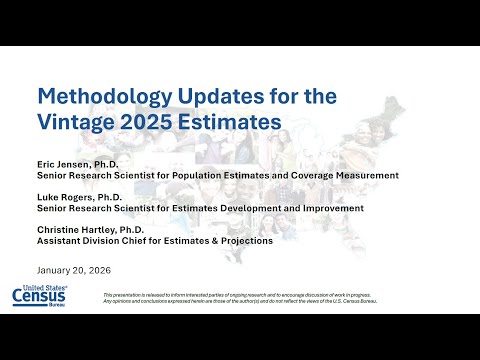
The U.S. Census Bureau said it will publish its Vintage 2025 population estimates next week and outlined key methodology changes including adoption of a 2020-based MARC file as the base, a single NCHS source for vital statistics, and revised international and domestic migration procedures.
The U.S. Census Bureau will publish its Vintage 2025 population estimates next week, and agency staff described several substantive methodological changes that users should expect to affect state and county totals as well as demographic characteristics.
"Today I'm going to be talking about methodology updates for the vintage 2025 estimates," Eric Jensen, senior research scientist for population estimates and coverage measurement, said during a public webinar previewing the release. Jensen said the Vintage 2025 release will cover the period from April 1, 2020, through July 1, 2025, and will include an updated time series of annual July 1 population values.
Why it matters: Census population estimates are widely used as controls for surveys such as the American Community Survey and the Current Population Survey, as denominators for public-health rates produced by the National Center for Health Statistics, and for program and planning decisions across federal, state, and local governments. Methodological shifts can therefore change the baseline counts used in many downstream analyses.
Major changes described
- New base file (MARC): Jensen said the agency is replacing the decade’s blended-base approach with a Modified Age and Race Census (MARC) base file built from 2020 Census data that have been reallocated into the race categories used by the Population Estimates Program and smoothed to address "age keeping" (age heaping). The MARC file lets the program use 2020 race and age distributions directly for the first time this decade.
- Vital statistics consolidated to NCHS: The office completed a multi‑vintage transition to using a single source of birth and death records from the National Center for Health Statistics (NCHS). Officials said NCHS data provide improved recency and better handling of residence versus occurrence for births and deaths.
- Migration methods and data updates: For domestic migration the program typically uses matched tax‑filing records; because of delayed delivery of the usual IRS cycle‑39 data the Census will use the cycle‑26 file for the 2024–25 domestic migration period. For older ages (65+), delays in Centers for Medicare & Medicaid Services (CMS) disclosure‑avoidance processing required the program to hold the most recent observed migration rates constant for the affected projection window. For net international migration (NIM), analysts adjusted three NIM subcomponents and said, for the 07/01/2024–06/30/2025 period, administrative benchmarks aligned with American Community Survey (ACS) estimates so no upward or downward benchmark adjustment was needed; the agency used Department of Justice Executive Office for Immigration Review (EOIR) data to allocate humanitarian migrants to likely states and counties.
- Emigration adjustments using external surveys: Because emigration is difficult to measure after people leave the United States, Census researchers tested external sources. Jensen said the office used Mexico’s National Survey of Occupation and Employment (noted in the webinar as a key external source) to adjust emigration flows to Mexico and made related assumptions to increase emigration to Central and South American countries where direct data were lacking. The program retained a residual method based primarily on the ACS to capture broader emigration patterns.
- Special census and group‑quarters handling: Vintage 2025 is the first vintage this decade to incorporate special census enumerations. The Census Bureau said it now applies linear interpolation between the 2020 base and the special census date to transition gradually to the special census values for group quarters and housing counts.
Release schedule and products
Jensen outlined a staged release: January will include population totals, components of change, and voting‑age population for the nation, states, and Puerto Rico; March will add metropolitan/micropolitan areas, counties, and Puerto Rico municipios; April will include national population by age; May will release city and town totals and housing units; and June will publish detailed characteristics such as race and Hispanic origin. Agency staff also said annual state‑level NIM through July 1, 2025, will be part of the next release, county‑level annual NIM will follow in March, and national monthly population projections will be provided through Dec. 1, 2026.
Questions from webinar participants and agency responses
During the question-and-answer period, Jensen and other Census staff addressed common user concerns. They said domestic and international migration methods are distinct and that immigrants assigned to a state in one year could appear as domestic out‑migrants in later years under the domestic method. On undocumented populations, Jensen said DHS produces separate estimates but those are typically several years old and not directly incorporated; the Census assumes the ACS includes undocumented residents but cannot be certain in years where it applies additional benchmark adjustments. On deportations, the Census noted border repatriations generally do not meet resident criteria and therefore do not remove people from the resident population, while interior repatriations have been relatively small for the vintage window.
What to expect next
The Census reminded users it will publish supporting documentation, a methods blog, and working papers coincident with the release (the agency said a NIM blog and other materials will be posted on the day of release). Staff urged users with further technical questions to contact the Population Estimates coordination, dissemination, and outreach branch at the address provided during the webinar.
The Census Bureau webinar concluded with staff reiterating that Vintage 2025 reflects a combination of new 2020 census base data, consolidated vital statistics from NCHS, adjustments to migration methods driven by newer information, and temporary workarounds where input datasets were delayed; the release is expected to show notable differences from prior vintages, especially in race distributions and areas affected by migration adjustments.