Get Full Government Meeting Transcripts, Videos, & Alerts Forever!
Get email alerts on the Governance Llcs topic
No spam. Unsubscribe anytime.
OHA trustees approve forming special-purpose LLCs for most fee lands after public objections on transparency
Summary
Trustees voted to authorize the creation of individual limited liability companies for most fee-owned OHA parcels (excluding Kakaʻako), with staff and consultant saying the structure offers liability protection and quarterly public reporting; one public testifier urged trustees to reject the plan citing transparency and accountability concerns.
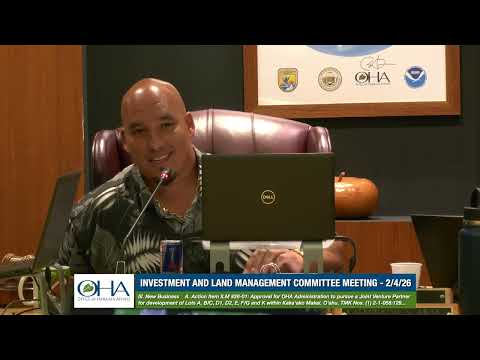
The Office of Hawaiian Affairs Committee on Investment and Land Management on Feb. 4 approved an administrative proposal to form special-purpose limited liability companies to hold OHA fee-owned properties, excluding Kakaʻako parcels.
Jermaine Myers, who identified himself as an OHA beneficiary, testified in strong opposition to ILM 26-02. Myers urged trustees to reject the proposal, arguing that LLCs “are designed to limit liability, compartmentalize risk, and separate ownership from accountability,” and warned that such structures can reduce transparency into financial records and decision making. “If these lands belong to the Lahui, why would we place them inside entities historically used to shield owners from scrutiny?” Myers asked.
Administration consultant Paul Quintiliani and staff said the proposed model is designed to preserve public oversight while gaining liability protections. Quintiliani said the board would act as the LLC member under policy, OHA staff would manage day-to-day operations, and major decisions would be reserved to the member. He said quarterly public reporting and compliance with sunshine laws are core parts of the proposal and that separate books, records and bank accounts would be maintained for each LLC.
Quintiliani also told trustees the proposed structure would differ from some prior OHA LLC arrangements in which separate boards and management had reduced transparency; the current proposal keeps decision-making authority with the trustees and builds public reporting requirements into policy.
Trustees asked whether individual parcels would be placed into separate LLCs or grouped. Paul and staff said the recommendation is one LLC per property (for fee parcels other than Kakaʻako) and that Kakaʻako was excluded from this action because a joint-venture solicitation for Kakaʻako had just been authorized. The administration indicated trustee training is recommended to ensure oversight without jeopardizing liability protections.
The motion to authorize formation of LLCs for fee-owned OHA parcels (with specified exceptions) passed on roll call; the chair announced the motion passed and recorded trustees’ affirmative votes with one trustee excused.
Why it matters: The change alters OHA’s legal ownership vehicle for many properties. Supporters say the approach balances liability protection and efficient asset management; opponents worry about reduced transparency and weaker public accountability if information becomes harder to access.
What’s next: Administration will work on LLC formation details, secure required lender approvals for specific properties, and present governing documents to the board for final approval.