
Judiciary committee tables foreclosure and title bill after debate over cash‑on‑the‑steps, certified funds and judicial security
Get AI-powered insights, summaries, and transcripts
Sign Up Free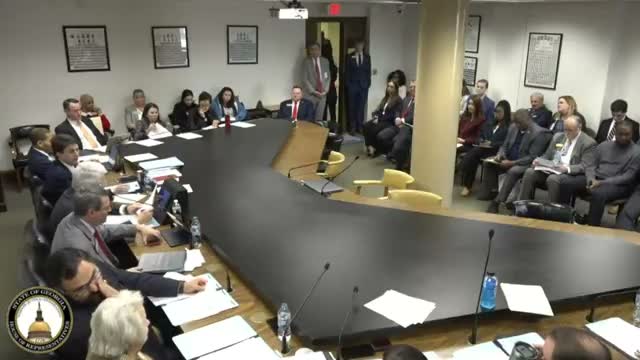
Summary
A substitute for House Bill 1042, a three‑part real estate security and title measure, drew extended committee scrutiny on removing cash from courthouse‑step foreclosure sales and on expanding protections for judges. Lawmakers tabled the bill for redrafting and asked sponsors to work with practitioners before the Monday calendar.
Vice Chair Reeves introduced a substitute to House Bill 1042, describing three separate components: redacting judges’ home addresses and related identifying parcel data for judicial security, expanding eligibility for special masters in foreclosure law, and allowing bidders at judicial foreclosure sales to use certified‑fund transfers or credit‑bid procedures rather than carrying cash or multiple cashier’s checks to courthouse steps.
"This is a follow‑up to make sure that judge's home addresses are redacted both on the address as well as the parcel ID," Vice Chair Reeves said, asking the committee for support and saying the measure had been vetted by title insurance companies, clerks and judicial counsel. Reeves also described security concerns raised after a judge was shot at home in another state and framed the address redaction element as a protective step.
The provision addressing foreclosure sales prompted the longest debate. Under current practice, lenders commonly make credit bids and finalize transfers after the sale, while non‑lender purchasers must appear with cash or cashier’s checks at the sale. The bill’s substitute would allow bidders to tender "certified funds" — broadly defined in committee testimony to include cashier’s checks, certified checks, wires to FDIC‑insured accounts and advance escrow transfers — and allow for a transfer process more like a conventional real‑estate closing.
"The intent was not to allow credit bidding by anyone other than the foreclosing lender," said Nick Rollader, a senior partner at McCullough Ramer Liebert Pierce, who testified as a practitioner. "What this amendment would allow is for a wire transfer, and presumably in advance of the foreclosure," he said, explaining that auction companies increasingly take advance deposits into escrow and that the language reflects that practice.
Several committee members raised operational and equity concerns. Representative Evans pressed that the change could "potentially cut out people that don't bank," and Representative Montaheen warned the unbanked or cash‑dependent buyers could be disadvantaged if required to transfer funds in advance. Members also questioned how long escrowed funds could be held if a bidder was unsuccessful and whether institutional bidders would gain an advantage.
Supporters stressed safety and anti‑money‑laundering goals. "Safety is the biggest one," Vice Chair Reeves said, explaining the risks of large anonymous cash transfers at courthouse steps and noting concerns about unaccounted for cash and related criminal activity. Witnesses also referenced regulatory trends, including a Financial Crimes Enforcement Network rule noted in testimony.
After extensive questioning and requests for clearer drafting on lines governing credit‑bid and certified‑fund mechanics, members asked the sponsor and practitioners to confer. The committee approved a motion to table the bill for further work and placed it on the Monday calendar for additional consideration. The transcript records the bill was tabled and to be revisited; no recorded roll‑call tally for the table motion appears in the hearing record.