Fremont officials present by-right zoning, in-house permitting and preserved industrial land as a model to retain manufacturers
Loading...
Summary
Fremont officials told the Senate committee their deliberate policies—preserving industrial land, by-right zoning for most manufacturing, an in-house hazardous materials program and workforce partnerships—helped the city host roughly 900 manufacturers and expand manufacturing employment.
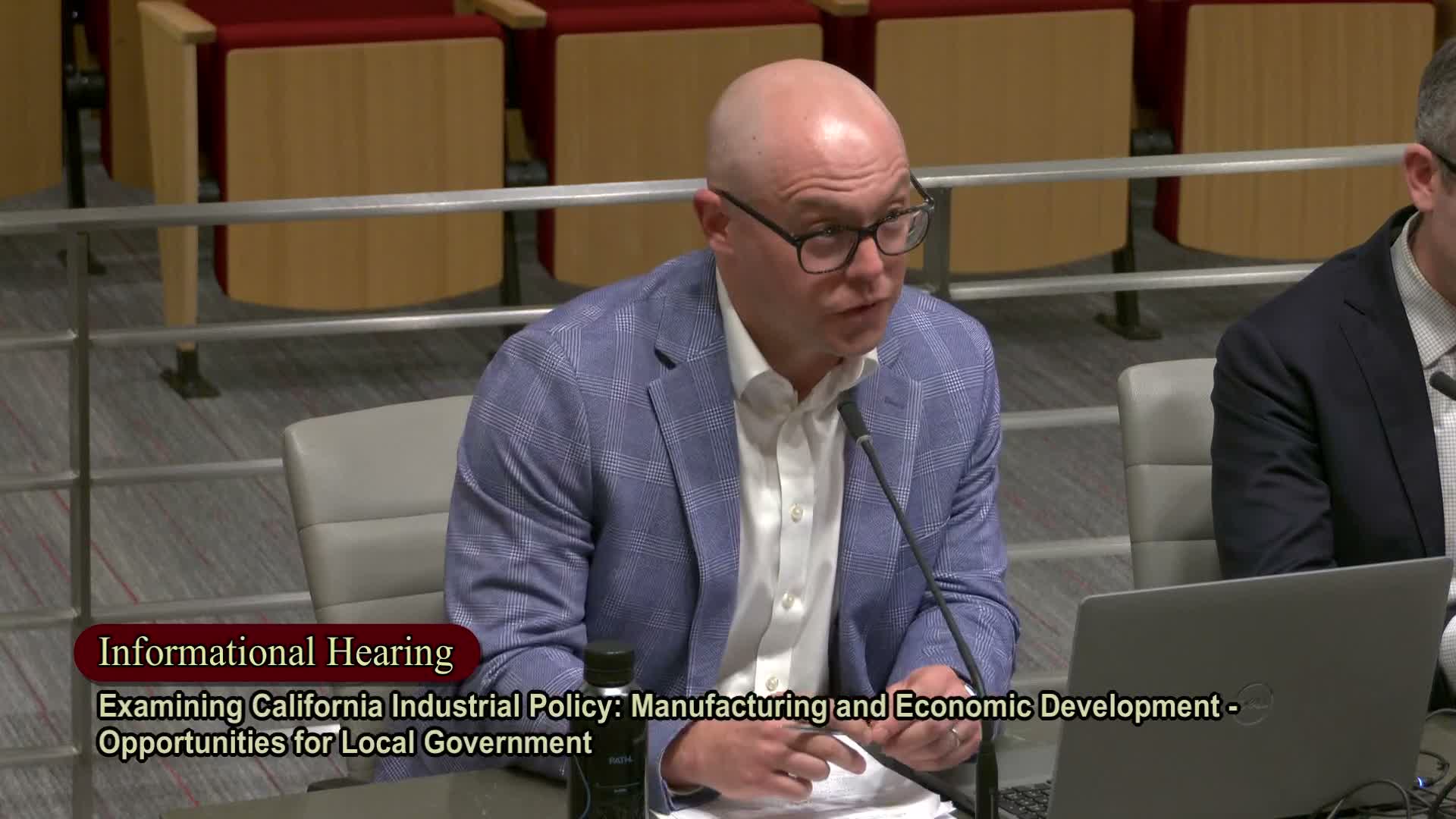
Donovan Lazaro, Fremonts economic development director, presented Fremont as a counterexample to statewide manufacturing decline, describing deliberate local policies that kept and expanded industry in the city.
Lazaro said Fremont is "the number 1 manufacturing city in California, home to approximately 900 manufacturing facilities" and that the citys industrial base exceeds 55,000,000 square feet. He credited by-right zoning for most manufacturing, which allows projects that meet zoning standards to proceed without discretionary review and can reduce CEQA exposure, and an in-house hazardous materials program that helps firms navigate state and federal regulatory frameworks.
Lazaro offered case studies: Boehringer Ingelheim scaled from a single leased building in 2011 to additional buildings and nearly 1,000 skilled manufacturing jobs because the city offered permitting predictability and helped secure power and regulatory approvals. He also noted Teslas expanded Fremont factory employs more than 25,000 workers and demonstrated that high-output manufacturing can remain in high-cost regions if cities preserve land and reduce development uncertainty.
Fremont officials and other witnesses urged the state to inventory and package existing state resources so local governments and firms can access financing, pre-apprenticeship pipelines and permitting assistance more easily. No new state policy was enacted in the hearing; witnesses recommended using the committees follow-up to explore how to replicate Fremonts tools elsewhere.