
Senate committee pushes for durable state industrial policy to keep manufacturing in California
Get AI-powered insights, summaries, and transcripts
Subscribe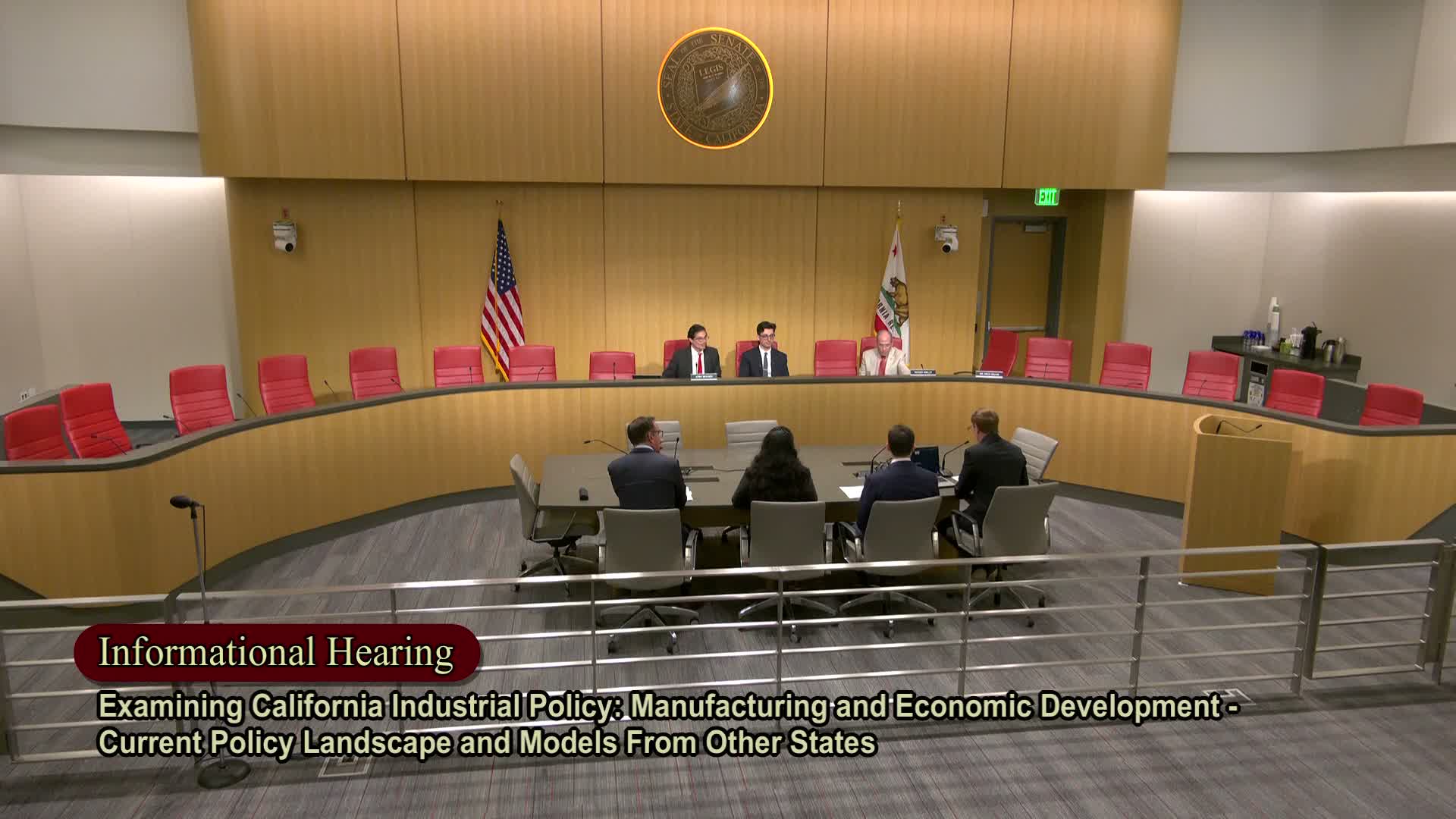
Summary
Witnesses at a California State Senate select committee hearing urged lawmakers to turn one-time Jobs First grants into a durable regional economic development system, coordinate utilities for timely power delivery, and target sector roadmaps—especially for batteries—to capture middle-stage manufacturing jobs.
Chair Becker convened the Select Committee on Economic Development and Technological Innovation to examine Californias industrial policy and the states ability to retain and scale manufacturing. The hearing framed the problem as a missing middle: California excels at research and invention but often loses large-scale manufacturing to other states and countries.
Egon Turpin, regionalism fellow at California Forward, told the committee the Community Economic Resilience Fund (now Jobs First) established regional strategic plans but was a one-time investment. "We need a durable structure for regions to have a partner with the state," Turpin said, noting Jobs First funding was not built for ongoing commitments. He urged an integrated state economic development plan tied to sustained regional funding and coordination.
Panelists and witnesses repeatedly stressed permitting timelines and regulatory uncertainty as decisive factors in companiess site decisions. A business development executive who led site searches for Bloom Energy and Cy Quantum said three power factors matter most—reliability, cost and timing—and emphasized "time to power" as the factor that can disqualify California. Multiple witnesses recommended early, coordinated engagement between utilities, state agencies and local governments so firms can secure electricity on the timeline they need.
Speakers from labor, industry and local government described a set of practical tools lawmakers can use: sector-specific roadmaps that align state resources to identified gaps, packaged state incentives and grant criteria tied to labor standards, and centralized navigation (a "concierge") to help firms access existing state programs. Tom Hintze of the UAW urged public financing and procurement with high-road labor and environmental conditions to prevent taxpayer-funded outsourcing.
The committee also heard that targeted sectorsnotably the battery supply chain, battery recycling, offshore wind components and heat pumpspresent opportunities to align climate and industrial goals. witnesses pointed to the mismatch between where R&D dollars flow and where downstream manufacturing scales up, calling for roadmaps and offtake strategies to stabilize demand for in-state producers.
The hearing concluded with a string of public comments urging that the state replicate local models that have preserved industrial land and provided predictability for manufacturers. Chair Becker said the committee will continue working with witnesses and staff to follow up on ideas raised during the hearing.