
Planning commission recommends approval for VCOM expansion at 1701 Craft Drive
Get AI-powered insights, summaries, and transcripts
Subscribe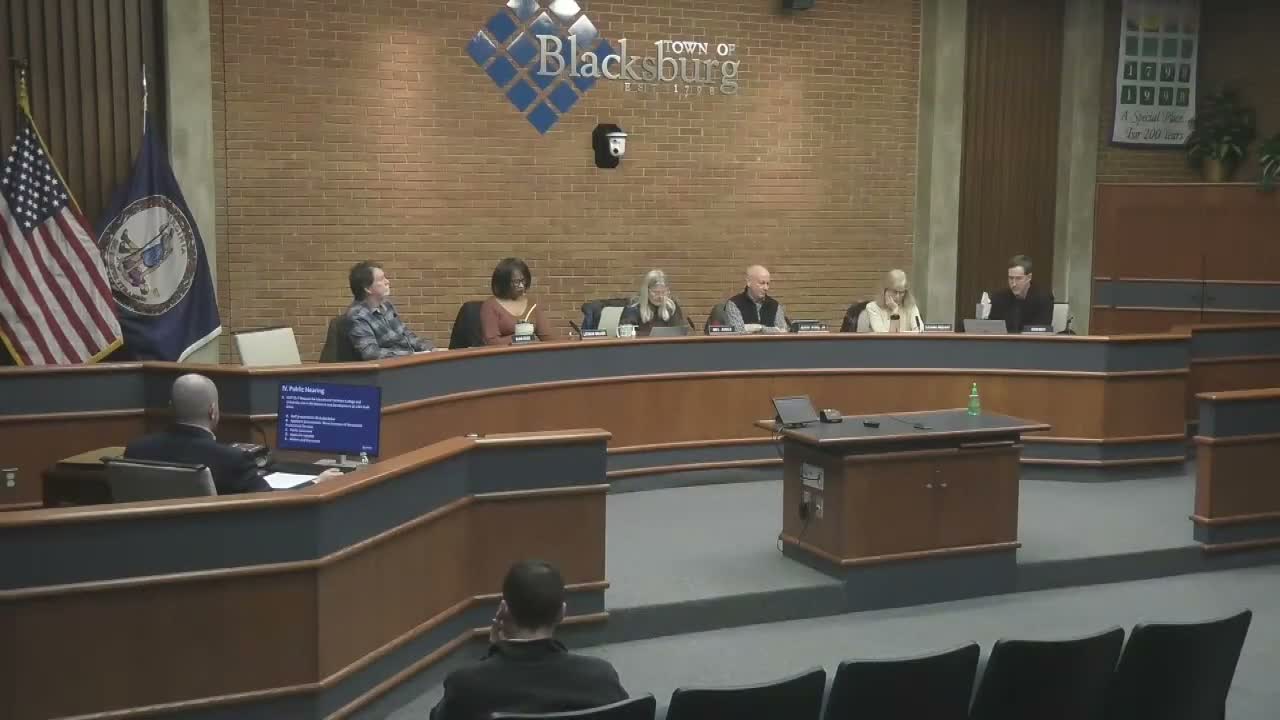
Summary
The Blacksburg Planning Commission unanimously recommended approval of CUP-25-7 to allow the Virginia College of Osteopathic Medicine to expand into a vacant 4.448-acre parcel at 1701 Craft Drive in the Virginia Tech Corporate Research Center; staff recommended three conditions including an on-site trail connection and required sign permits.
The Blacksburg Planning Commission on the evening of the regular meeting voted to recommend approval of CUP-25-7, a conditional use permit that would allow the Virginia College of Osteopathic Medicine (VCOM) to expand operations onto a 4.448-acre parcel at 1701 Craft Drive in the Virginia Tech Corporate Research Center.
Staff planner Nick Baker told the commission the proposed educational use fits within the site’s Research and Development future land use designation and noted the parcel had previously supported office and research uses. The project would renovate the existing two-story building and add a two-story north-side addition totaling 16,200 square feet for laboratories, lecture halls and classroom space. "The applicants are proposing a new 2 story addition to the north side of the building, which would add a total of 16,200 square feet of new usable space," Baker said.
Why it matters: the expansion is intended to support additional medical education capacity in the region and would alter site circulation and parking. Staff said the applicant proposes to increase vehicle parking from 129 spaces to 239 spaces (based on a 1 space per 250-square-feet ratio) and to provide 22 bicycle parking spaces. The proposal also includes a 5,000-square-foot outdoor amenity area and a 10-foot asphalt multi-use trail intended to connect the site to adjacent housing.
Engineering staff flagged site-capacity issues at the site-plan stage but told the commission that a revised stormwater concept plan, previously denied, received approval earlier the same day. Baker summarized staff’s recommended conditions: (1) substantial conformance to the most recent submittal date; (2) installation of the walking/trail connection that links the site to nearby apartments; and (3) sign permits must be applied for and approved prior to any signage installation.
Applicant representative Mr. Norris of Westmore Professional Services told the commission the corridor committee and staff asked for the trail connection and the team revised plans accordingly. "Obviously, the biggest thing we talked about at our work session was the trail connection," Norris said, adding the design allows variable widths to avoid existing stormwater infrastructure. He and VCOM’s John Wassel said they had obtained executive committee approval at the Corporate Research Center for the site plan and sign locations and will return to that committee for final building architecture review.
Commissioners pressed about the project timeline and pedestrian access between VCOM locations and nearby housing. The applicant said they expect construction and permitting to progress as quickly as possible with a target of summer operations if permits and systems are pulled in time. The applicant also explained the trail and accessible route were required to meet town code standards for access to the building from the public sidewalk.
Signs and buffers: the applicant requests a Special Science District to permit two monument signs (a roughly 42-foot sign at Research Center Drive/Grama Drive and a roughly 23-foot off-site monument sign on adjacent property). They also seek a reduction in the required buffer yard to a Type B buffer citing roughly 20 feet of elevation change between the properties as a natural visual and sound barrier to justify relief to enable the walking connection and expanded amenity.
The vote: a commissioner moved and another seconded the motion to recommend approval of CUP-25-7 with the three staff conditions; the commission voted in favor with no opposition.
Next steps: the Planning Commission’s recommendation will be forwarded to the Town Council (or other final decision-making authority) for action consistent with the town’s review process. Additional engineering, site-plan level reviews and sign-permit approvals are required before construction or signage installation may occur.