Get Full Government Meeting Transcripts, Videos, & Alerts Forever!
Get email alerts on the Fleet Policy topic
No spam. Unsubscribe anytime.
South Pasadena council adopts modern fleet replacement policy after Tesla patrol review
Summary
Council adopted a new fleet replacement policy that prefers electric and zero‑emission vehicles while allowing documented exceptions for mission‑critical uses, after staff presented two years of Tesla patrol data showing operating savings but also operational limits. Council added requirements to show CARB/ACF compliance and public‑health language.
The South Pasadena City Council on Feb. 4 adopted a revamped fleet replacement policy that directs city departments to prefer electric and zero‑emission vehicles but allows documented exceptions when operational needs or safety concerns require non‑EVs.
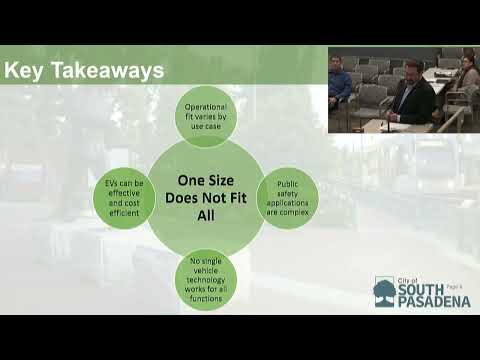
Staff presented a two‑part report examining financial, environmental and operational results from the city’s all‑Tesla police fleet and a broader analysis of municipal vehicle replacement. "EV patrol vehicles cost roughly one‑third to one‑half the cost per mile of traditional gas patrol vehicles," Assistant to the City Manager Nick Kimball said, citing 18 months of performance and a five‑to‑six‑year lease‑period cost model.
The council’s decision followed questions from members about public‑health metrics and compliance with state rules. Councilmembers asked staff to add a concise health‑impacts paragraph and to make compliance with the California Air Resources Board Advanced Clean Fleets regulation explicit in the policy. "I would like the policy to be implemented in a manner that ensures full compliance with applicable state and federal fleet regulations, including the California Air Resources Board Advanced Clean Fleets regulation," one councilmember said during the discussion.
Why it matters: South Pasadena’s police department replaced 20 patrol vehicles under a lease program starting in 2022. Staff estimated net lifecycle costs to the city and said grant funding reduced upfront capital costs for charging infrastructure; the presentation also showed estimated carbon‑emissions savings and operating‑cost breakeven around two years in some scenarios.
What staff told the council: Kimball said the fleet program delivered operating savings driven by lower fuel and maintenance costs, and that grants had cut the net infrastructure cost for Level 3 chargers from roughly $600,000 to about $470,000 net to the city. He also summarized patrol officers’ feedback: "Officers reported strong performance advantages, particularly acceleration and torque," he said, but also noted complaints about cabin size, prisoner transport, seating ergonomics, pursuit capability and range during extended mutual‑aid responses.
Council direction and next steps: The council voted to adopt the policy with amendments that (1) add explicit language requiring implementation to comply with the CARB Advanced Clean Fleets rules where they apply, (2) add a short health‑impacts statement or attachment and (3) require staff to include CO2 and particulate‑emissions data, grant credits and clear apples‑to‑apples comparisons in future purchase recommendations. Staff said individual vehicle replacement decisions will return to council when thresholds (for example purchases above $30,000) or department uses make public review appropriate.
The council’s action was procedural and did not authorize the immediate purchase of specific vehicles; rather, it establishes a framework for future decisions and data‑driven comparisons. Staff also signaled it will plan for a vehicle replacement reserve and stagger purchases to avoid mass replacements that strain budgets and operations.