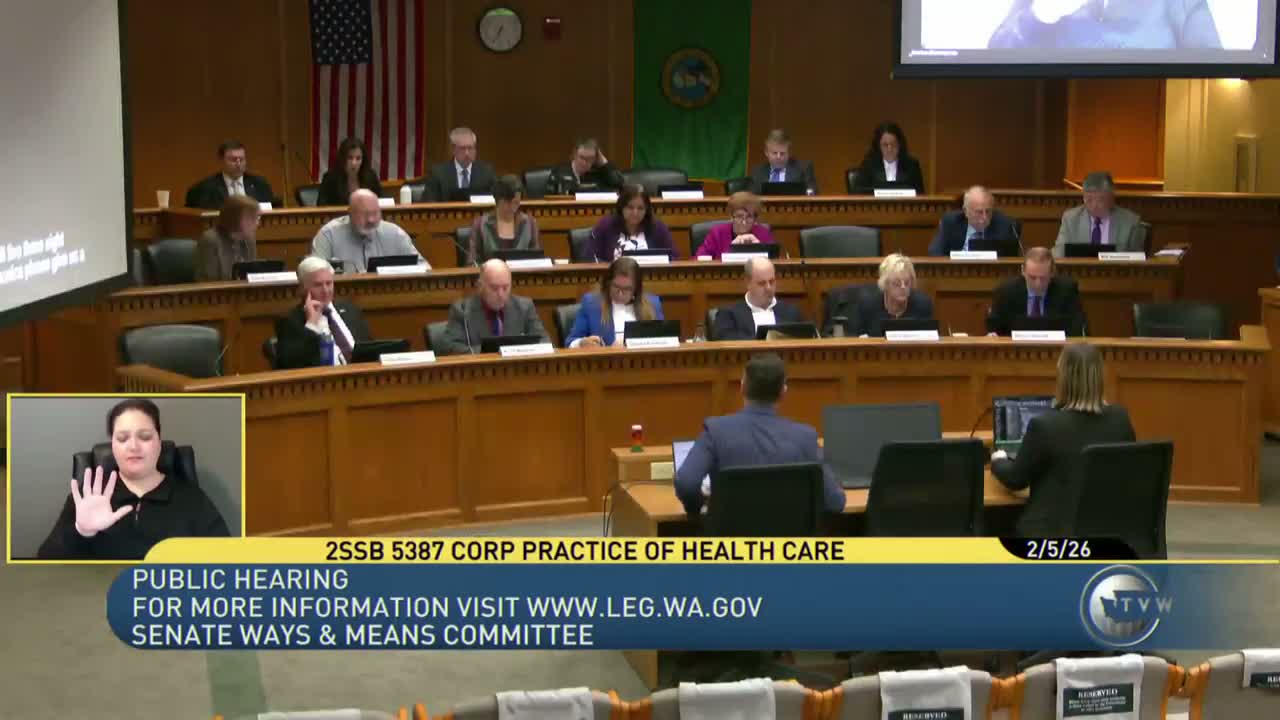
Committee weighs limits on non‑clinician control of medical practices; providers split
Loading...
Summary
A second substitute to SSB 5,387 would tighten rules defining corporate practice of medicine and restrict non‑licensed control over clinical decisions. The Department of Health flagged enforcement costs; physician groups and patient advocates support protections for clinical autonomy while many provider groups and management‑service organizations warn the bill could force practice closures or consolidation.
Greg Attenaccio and colleagues from the Health & Long‑Term Care Committee described SSB 5,387 as a three‑part package: rules governing professional service corporations that run medical practices (limiting ownership and board control to licensed medical providers), protections forbidding outside entities from directing professional judgment in hospitals and other licensed facilities, and new attestation and disciplinary language for medical licensees.
The Department of Health's fiscal estimate projected initial administrative and enforcement costs and a multi‑year increase in complaint‑handling workload (the department estimated a need for additional FTEs under some scenarios). The bill would make certain violations unprofessional conduct for licensees and allow sanctions.
Testimony divided sharply. Medical societies, patient groups and advocacy organizations urged safeguards against private‑equity or investor‑driven clinical interference, citing rising consolidation and price increases. Doctors and clinicians recounted examples where financial pressures affected staffing and decision latitude and supported stronger guardrails.
Opponents — including independent physician associations, management‑service organizations and many specialty practices — warned the bill in current draft would make common MSO‑physician arrangements illegal or impractical and could reduce access to outpatient services, particularly in rural areas. They urged narrower, surgical language to preserve legitimate nonclinical support functions while protecting clinical autonomy.
Several witnesses proposed alternate approaches, such as model bylaws, targeted disclosure and strengthened whistleblower protections instead of broad ownership restrictions.
The committee heard extensive public comment and did not move the bill to a vote that day.
Quote: "Clinical decisions are made solely by licensed clinicians," said a coalition witness arguing for reforms to limit financial owners from overriding clinician judgment.