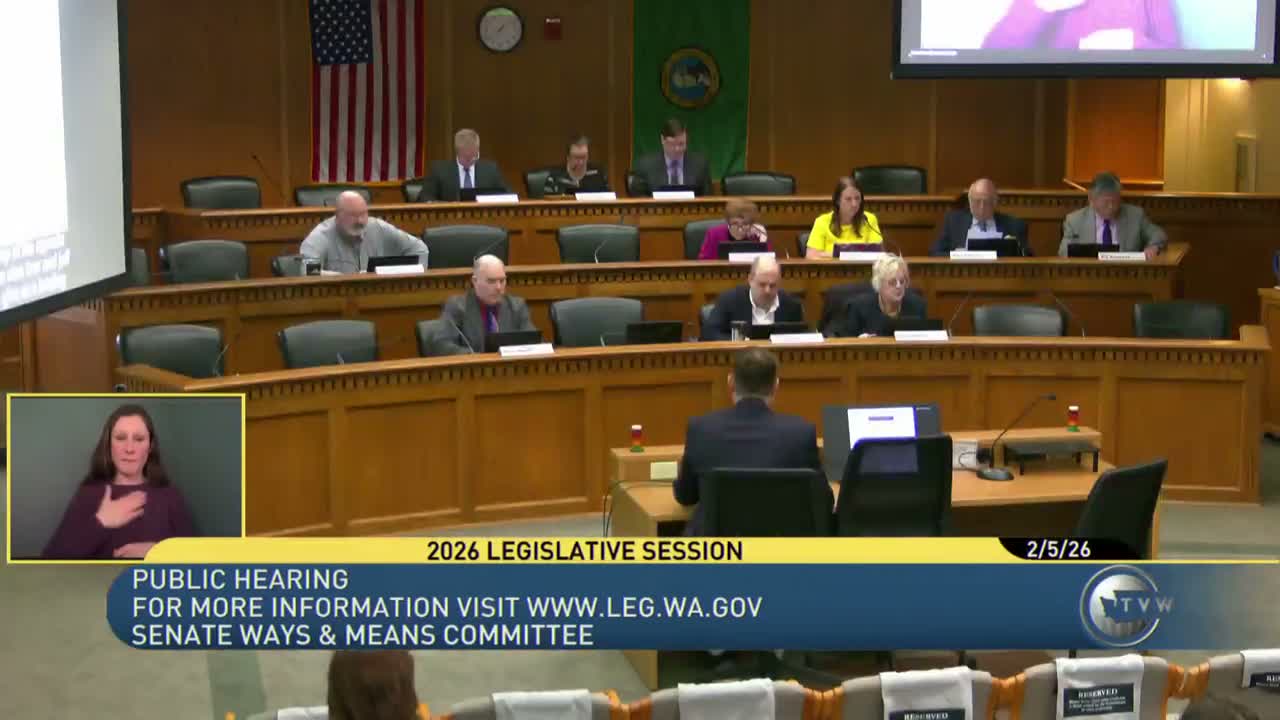
Committee hears broad package giving counties new revenue tools and REIT flexibility
Loading...
Summary
Senate Bill 6,294 would expand local revenue options — including new uses for REET 2, a county public utility tax option, a one‑tenth percent sales tax for children and family services, and standalone levies for veterans and mental‑health assistance. Proponents say counties need new tools; utilities, cannabis and retail groups raised distributional and market concerns.
Jeff Mitchell, staff for the committee, described SB 6,294 as an eight‑part approach to expand local fiscal flexibility. Key provisions include expanding allowable uses of certain real estate excise tax (REET) proceeds to allow nuisance abatement and rehabilitation of existing affordable housing; allowing cities (with voter approval) to impose an affordable‑housing REIT; authorizing counties to impose a public utility tax up to 3% (with a required 0.2% set‑aside for low‑income utility assistance); authorizing a new 0.01% local sales/use tax for services to assist children and families (child care, perinatal supports, before/after school programs); broadening the allowed uses of an existing housing sales tax to include rental assistance and rehabilitation of existing affordable housing; permitting counties to create standalone levies for veterans and mental‑health assistance; lengthening lid‑lift durations; and allowing counties to use rental‑car tax revenues for criminal‑justice purposes.
Mitchell summarized the fiscal notes: a small statewide revenue increase is anticipated from some components while others carry an expenditure impact and local review costs — and the bill’s net four‑year state cost was calculated in staff materials as approximately a $1.3 million net cost when certain administrative fees are included. During public testimony, counties, cities, the Association of Washington Cities, and the Washington State Association of Counties urged the bill as a necessary set of tools for fiscally constrained local governments.
Several industry witnesses raised objections to specific parts: CTIA and wireless industry representatives said a new county utility tax would be regressive for low‑income wireless consumers; sewer and water districts warned that a utility tax could force rate increases on essential drinking‑water services; auto dealers and business groups urged voter approval for new sales taxes; and cannabis industry groups strongly opposed any increase to the cannabis excise tax portion (SB 5,650) arguing it would drive further illicit market activity and harm small licensees. County officials and proponents responded that the utility tax in the bill is intentionally set lower than city/county maximums (3% vs. higher rates) and that a portion would be dedicated to low‑income assistance and that local voter approval would remain required in some instances.
Public testimony included local public‑health and human‑services advocates urging inclusion of public health clinic funding language from a related house bill and county officials emphasizing the revenue options’ role in funding child and family services and infrastructure.
The committee did not enact final action that day; staff and sponsors fielded clarifying questions on levy structure, voter approval, and interaction with existing local authority.
Quote (from staff): "Parts 1 and 2 of the bill relate to local real estate excise taxes...part 3 allows counties to impose a local public utility tax on utility services to consumers in unincorporated areas of the county."