Get Full Government Meeting Transcripts, Videos, & Alerts Forever!
Get email alerts on the Land Use topic
No spam. Unsubscribe anytime.
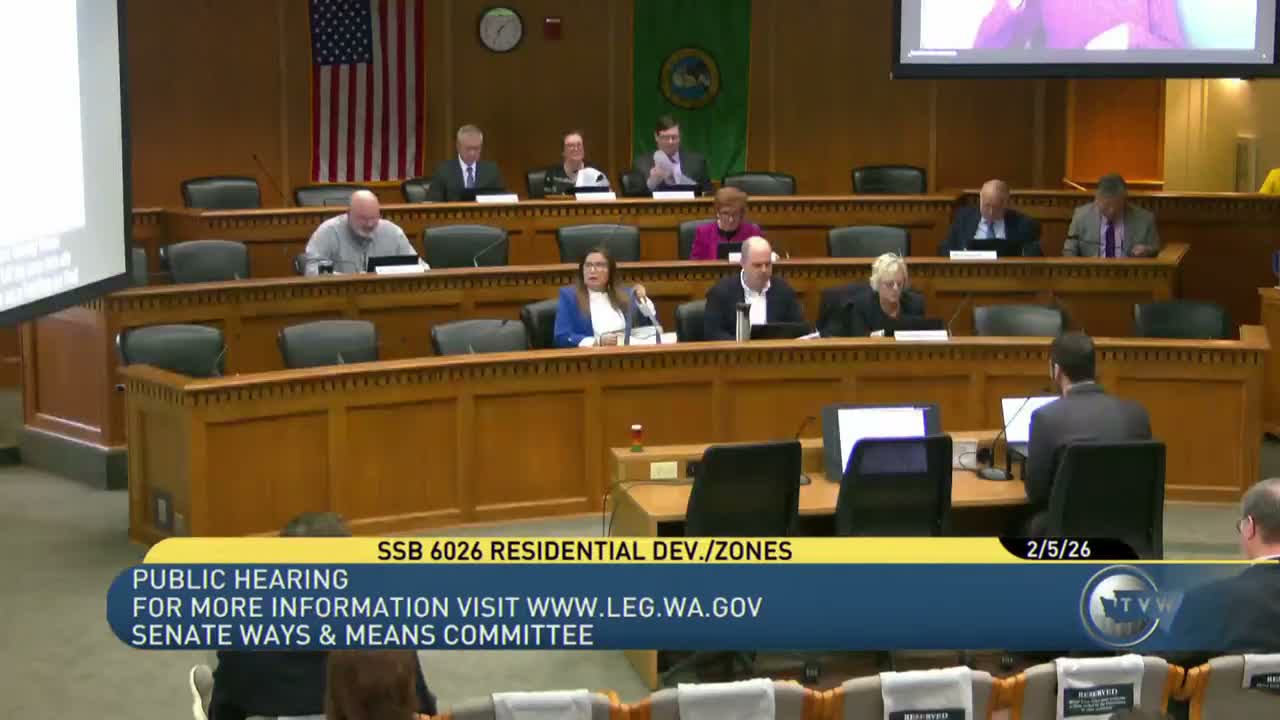
Senate committee hears bill to allow more housing in commercial and mixed‑use zones
Summary
A substitute bill would require many cities and counties to allow residential uses in commercial or mixed‑use zones, loosen ground‑floor retail requirements in most places and offer limited height incentives where cities keep commercial floors. Supporters say it will add housing capacity; opponents warn of local economic impacts.
Trevor Press, staff for the Senate Ways and Means Committee, told members the substitute to Senate Bill 6,026 would require cities and counties that plan under the Growth Management Act and have populations above 30,000 to allow residential uses in areas zoned for commercial or mixed use while laying out limited exceptions and conditions.
The staff briefing said the bill is a governor-request measure intended to increase housing capacity without forcing ground-floor retail in every commercial area. Press said cities that elect to keep mixed‑use or ground‑floor commercial requirements could do so for station areas or for up to 20% of zoned area outside stations, and where those requirements apply jurisdictions must allow modest height increases. The Department of Commerce fiscal note cited $130,000 in FY27 and $380,000 over the 4‑year outlook to provide 0.7 FTE for technical assistance and guidance updates.
Lieutenant Governor Hack, testifying in support, framed the bill as one of the session’s most important housing measures. “There is great potential to add needed housing by pursuing this path,” he told the committee, arguing that removing mandatory ground‑floor retail requirements in many places would unlock space for homes without “settling those homes with the burden” of retail conditions.
Supporters from housing advocates, builders and planning groups said the proposal would convert underused commercial land and aging strip malls into housing, help meet long‑term growth targets and expand affordable‑housing tools. Members of the building industry and local governments said they welcome flexibility but asked for clearer exemptions for station areas, adopted subarea plans, and for cities that depend heavily on sales tax from commercial corridors.
Opponents including some cities, ports and county officials said the measure, as drafted, could reduce sales‑tax revenues, remove local zoning tools and undermine adopted comprehensive plans. Several local governments urged targeted amendments to protect employment lands, clarify the 20% allowance outside station areas, and avoid unintended losses of small‑business and tax base capacity.
The committee did not take final action on the bill during this hearing; staff and sponsors said they were continuing stakeholder conversations to narrow exemptions and implementation details.