
Catalina Foothills Unified study session reviews discipline rules, due process and reporting
Get AI-powered insights, summaries, and transcripts
Subscribe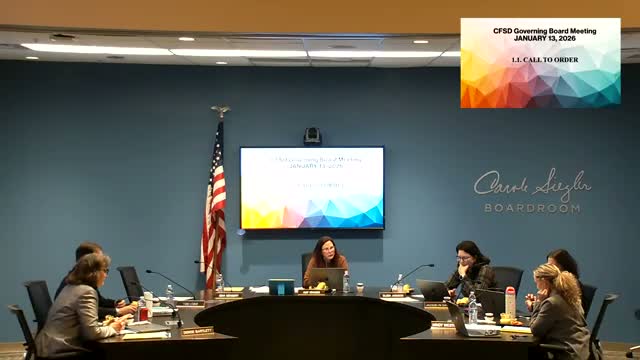
Summary
Associate Superintendent Mindy Westover led a Jan. 13 study session for the Catalina Foothills Unified School District governing board that reviewed student conduct and discipline policies (JIC, JK, JKD), special-education protections, restraints/seclusion rules, the discipline matrix and how Synergy flags reportable incidents; no actions were taken.
Associate Superintendent Mindy Westover led a Jan. 13 study session for the Catalina Foothills Unified School District governing board to explain how the district's student-conduct and discipline policies work together and what administrators must consider before imposing discipline.
"The purpose is to build an understanding of how our policies work together and provide legal guardrails for our discipline decisions and procedures," Westover said, framing the presentation as informational and not requiring board action. She reviewed policy JIC (student conduct) and policy JK (student discipline), related regulations and the district's discipline matrix.
Why it matters: Westover told the board the matrix and supporting regulations are intended to promote consistency while leaving room for administrators' professional judgment. The district uses Synergy, its student-information system, to record incidents; selecting certain offense codes in Synergy will flag required reporting to law enforcement and to the state.
Scope and off-campus jurisdiction: Westover explained that law and district practice often treat responsibility as extending from "doorstep to doorstep," but emphasized that the district only disciplines off-campus conduct that meets the policy's threshold (conduct that significantly disrupts the educational environment or raises safety concerns). "We are technically responsible for them from when they touch ground," Westover said, but she urged the board to recognize the practical and legal nuances when deciding whether to discipline off-campus acts.
Investigation and due process: Westover said due process requires administrators to tell students what they are accused of and give them a chance to respond; older students often receive both verbal and written notice. For longer suspensions, she said, the district follows more formal procedures and may seek legal counsel. Board members were told that administrators' documentation (often entered into Synergy) is important evidence if a case is appealed.
Students with disabilities: Westover reviewed how IDEA protections apply. If suspensions exceed 10 days, a manifestation-determination meeting is required to decide whether a student's disability caused the conduct; if so, the IEP team must consider supports and placement rather than automatic removal.
Restraints and seclusion: Westover said restraints and seclusion are emergency safety measures, not disciplinary tools. "They are only for imminent risk and danger," she said, and must end once the danger subsides. District policy requires that staff who perform restraints be trained, that an observer be present to document duration and behavior, and that parents be notified immediately.
Discipline matrix and examples: Westover walked the board through the matrix, which categorizes offenses and lists minimum and maximum consequence ranges rather than a single mandated outcome in most cases. Using a middle-school vape scenario, she described the typical sequence: report, investigation, interview, reasonable search, confiscation and parental notification. She said nicotine vapes are treated differently from suspected marijuana; marijuana in school is reportable and may require law-enforcement involvement. Administrators may consult SROs when the substance or situation is unclear.
Suspensions and appeals: Westover defined short-term suspension as fewer than 10 days (informal process) and long-term suspension as requiring a formal hearing and greater legal protections, including the right to counsel; long-term suspension decisions can be appealed to the governing board. She noted limits and special rules for younger students and for students who receive special services.
Data, monitoring and board oversight: The district monitors discipline data in Synergy and provides regular reports to the board; Westover said the district produces weekly reports on out-of-school suspensions (though monthly reporting is the formal mandate) and is working to reduce out-of-school suspensions through interventions and MTSS/PBIS supports.
Law-enforcement balance and SRO role: Board members discussed the district's philosophy of avoiding funneling students into the juvenile-justice system when possible. Westover said required reports are made per Arizona law, but discretionary referrals (for nicotine vapes, truancy and similar matters) are approached cautiously and often handled with tiered interventions. She described SROs as serving educational as well as safety roles.
Next step: The presentation was instructional; the study session paused so the governing board could convene its regular meeting. No motions or votes were taken during the study session.