
DOE’s Wright says U.S. and allies can fill oil supply gaps; predicts Venezuelan output could rise
Get AI-powered insights, summaries, and transcripts
Subscribe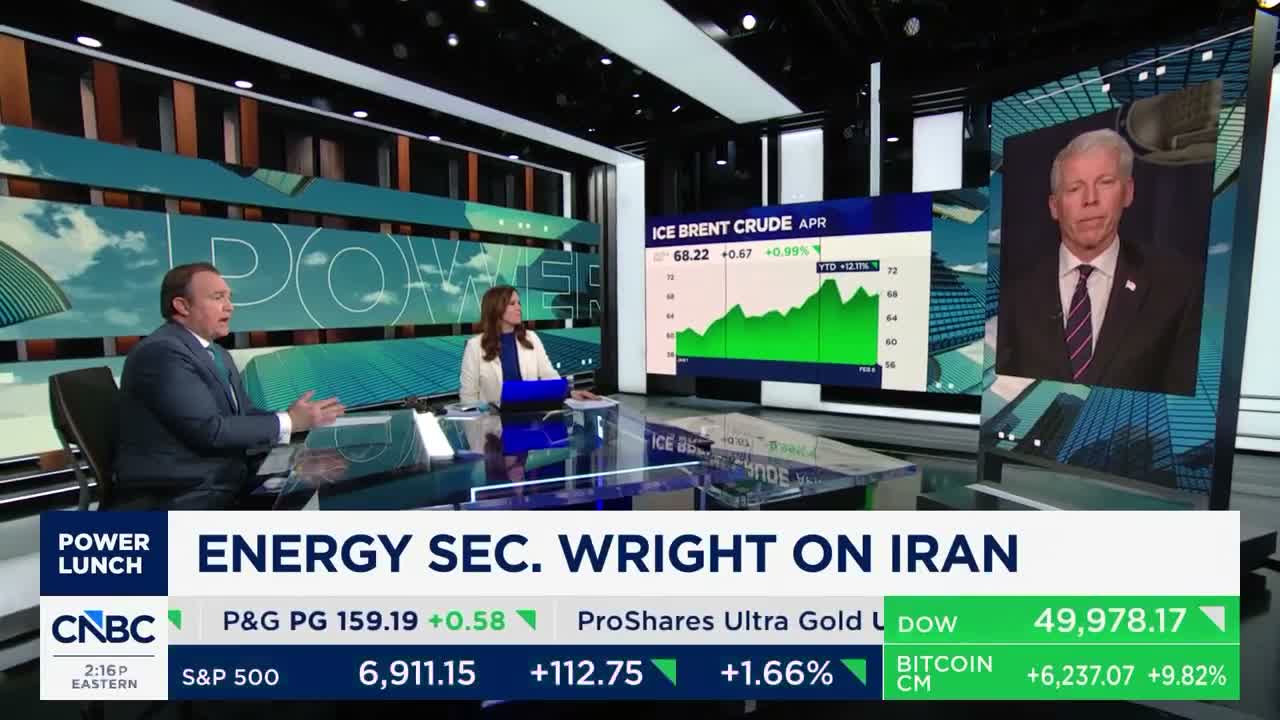
Summary
Energy Secretary Christopher Wright said the United States and allied producers can fill potential global oil supply gaps tied to Iran, and predicted Venezuela—currently producing about 900,000 barrels per day—could add several hundred thousand barrels this year if conditions change.
Energy Secretary Christopher Wright said in an interview that the United States together with allied producers could fill potential global oil supply gaps tied to tensions with Iran, and he predicted that Venezuelan output could rise substantially this year.
When asked about a worst-case disruption tied to Iran that might remove roughly 3.2 million barrels per day from markets, Wright said, "The broader energy sector, The United States and all our allied nations can absolutely fill that gap." He credited the administration’s agenda to grow American energy production for bolstering market resilience.
Wright described Venezuela as currently producing "about 900,000 barrels of oil a day" but said the country "has the potential to produce vastly more." He said U.S. policy toward Venezuela seeks to change behavior "without American troops on the ground, but simply with energy and with commerce," and that controlling Venezuelan oil sales could be used to bring stability and encourage production growth.
"I think you'll see several 100,000 barrels a day of growth in Venezuelan production this year," Wright said, adding that increased Venezuelan output would help stabilize global energy markets and supply heavy crude compatible with many U.S. refineries.
The host also noted Brent crude had risen above $68 a barrel and asked whether the U.S. oil and gas industry had the capacity and wherewithal to fill a large shortfall. Wright reiterated confidence in U.S. and allied production and tied the outlook to broader geopolitical strategy.
The interview conveyed policy views and operational assessments but did not announce new sanctions, production mandates or specific federal actions. Wright’s remarks focused on market resilience, U.S. production capacity and how policy tools could influence Venezuelan production and global supply.