Lifetime Citizen Portal Access — AI Briefings, Alerts & Unlimited Follows
DOE says secretarial orders, backup generators and large crews limited outages during winter storm
Loading...
Summary
Department of Energy officials said secretarial orders to prioritize dispatchable generation, activation of backup generators and interagency coordination helped prevent wider blackouts during a multi‑day winter storm, while officials defended keeping coal and gas assets available for emergencies.
WASHINGTON — Department of Energy officials said actions taken during a recent multi‑day winter storm — including secretarial orders to retain dispatchable generation, temporary waivers for some emissions limits and the use of backup generation at industrial sites — helped avoid wider outages.
"We made available also through secretarial orders all of the backup generation," Deputy Secretary James Stanley said, describing steps that allowed utilities to use industrial and commercial backup assets and temporarily relieve generators of certain annualized emissions limits during the emergency. He said the effort, combined with mutual‑assistance crews, helped reduce peak outages from about 1,000,000 to less than 20,000 in the days after the storm.
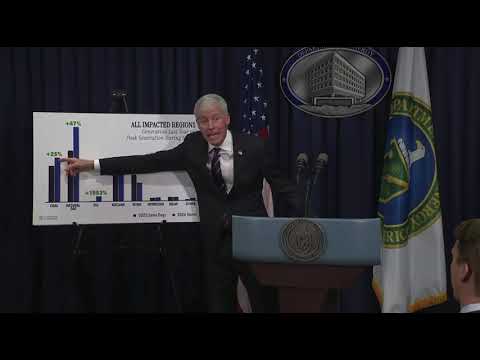
The secretary framed DOE policy during his opening remarks around "humans" and reliability, saying natural gas and coal ramped up during peak demand and that nuclear remained steady. "Natural gas increased its electric generation at that peak demand time 47% higher than it was a year ago at that same time in the wintertime," Secretary Wright said, and he added coal increased output "25%" at peak compared with a year earlier. Wright argued those dispatchable resources were decisive in keeping power flowing during the critical hours.
DOE officials also emphasized coordination with other agencies and the electric sector. "We had crews moving from state to state offering assistance," Stanley said, pointing to mutual‑assistance programs and coordination with the U.S. Army Corps of Engineers, the Department of Homeland Security, utilities and balancing authorities.
Officials cautioned that variable renewables performed poorly at critical moments of the storm. Wright said wind underdelivered relative to its capacity and that solar produced little during the winter event; he stressed that nameplate capacity does not equal delivered output at peak demand. "If you wanna add to the capacity of our electricity grid ... you have to add to our peak generating dispatch ability at that peak demand time," he said.
DOE said it used emergency authorities and coordination to maintain sufficient capacity; officials described those measures as temporary, targeted responses to an emergency rather than permanent regulatory changes. No formal vote or new statute was announced at the briefing; the actions described were executive measures the department said it deployed under its existing authorities.
DOE officials also noted logistics as a primary reason for slower restoration in some locations: many outages stemmed from icing on local distribution lines and damage to poles that required crews to travel to remote sites.
The department said it will continue studies on resource adequacy, gas‑electric coordination and long‑duration storage, and that it is supporting research and programs to increase grid resilience.
What happens next: DOE officials said they will continue coordination with regional grid operators and industry to analyze performance during the storm and to recommend investments in generation, grid maintenance and longer‑duration storage technologies.