Atherton workshop weighs charter city option; residents split over taxes, prevailing-wage impacts
Loading...
Summary
Town staff outlined a short draft charter and fielded residents’ concerns about whether home-rule status would let Atherton change contracting rules or lower tax vote thresholds. Speakers debated trade-offs including legal risk, grant-related prevailing-wage obligations and modest election costs.
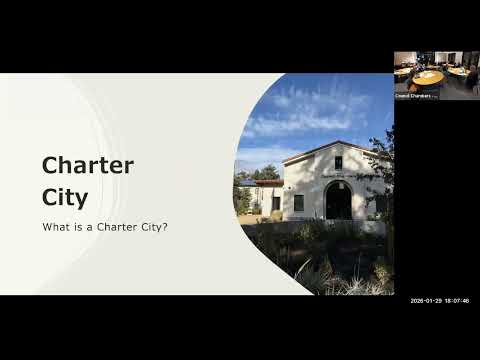
ATHERTON — Town staff and residents gathered for a public workshop to discuss a two-page draft charter that would give the Town of Atherton home-rule authority over certain local municipal affairs while preserving compliance with state laws that are deemed matters of statewide concern.
City Manager George Roberts opened the meeting and framed the discussion as a high-level review of the draft charter and the options it would create. "My presentation tonight is just flat out objective," Roberts said, adding the draft is intentionally brief and would not itself impose new taxes or change land-use rules.
The workshop highlighted two central trade-offs. Proponents and some residents said a charter could allow more local control over procurement and municipal procedures. Residents who pushed the idea earlier also pointed to potential flexibility on prevailing-wage rules and local contracting. "We can hire whoever we want, and we don't have to pay prevailing state wages," one resident said while recounting earlier research into charters.
Town Attorney Mona Ebrahim cautioned that legal limits and outside funding would constrain any local exemptions. She pointed to a recent state court development and to the legislature’s power to declare certain issues (including major housing laws) matters of statewide concern. "The California Supreme Court just issued a decision about a month ago, confirming that a charter city that exempts itself from prevailing wages, can do so," Ebrahim said, but she added that "in the future, the legislature can enact new laws" that would still bind charter cities on housing-related matters.
Discussion of taxes drew notable concern. Under current state law, certain special taxes require supermajority approval; the town attorney explained that a charter can be written to reserve broader taxing authority to the town and to make some special taxes (including parcels or transfer taxes) subject to a simple-majority vote if the charter affirmatively grants that power. Participants worried that language in a charter could make it easier for future voters to approve parcel or transfer taxes that previously required two-thirds support.
Several residents raised concrete fiscal and procurement examples. One attendee said the town previously paid more than $1,000,000 for a playground renovation and suggested that exemptions from prevailing-wage requirements might lower costs and attract more bidders. Another speaker who identified experience as a builder rejected the claim that prevailing wages raise quality, saying, "Well, as a builder, I can tell you that's hogwash." Staff and residents countered that many Atherton capital projects rely on federal, state or county grants, and accepting such funds typically triggers prevailing-wage and certified-payroll requirements that would apply regardless of a local charter.
On timing and cost, staff said charter changes must go before voters at a general election and can be slower and more expensive to alter than municipal code. Roberts estimated that adding a charter question to the November ballot would result in only a modest incremental cost (roughly $7,000) if the town uses an existing election cycle; separate or additional outreach and consulting costs would increase the total.
Council sentiment reported at the workshop was mixed: some council members see limited benefit now—given recent state housing laws—while others want to preserve the option for future changes. Staff outlined a public outreach plan that includes additional neighborhood meetings in March and a wrap-up workshop at the end of April, with possible council consideration in May or June.
The workshop ended with no formal action. Roberts said staff will compile community feedback and return to the council later this year with recommendations and next steps.