
Committee reviews Act 78 recommendations to create statewide dispatch governance board
Get AI-powered insights, summaries, and transcripts
Subscribe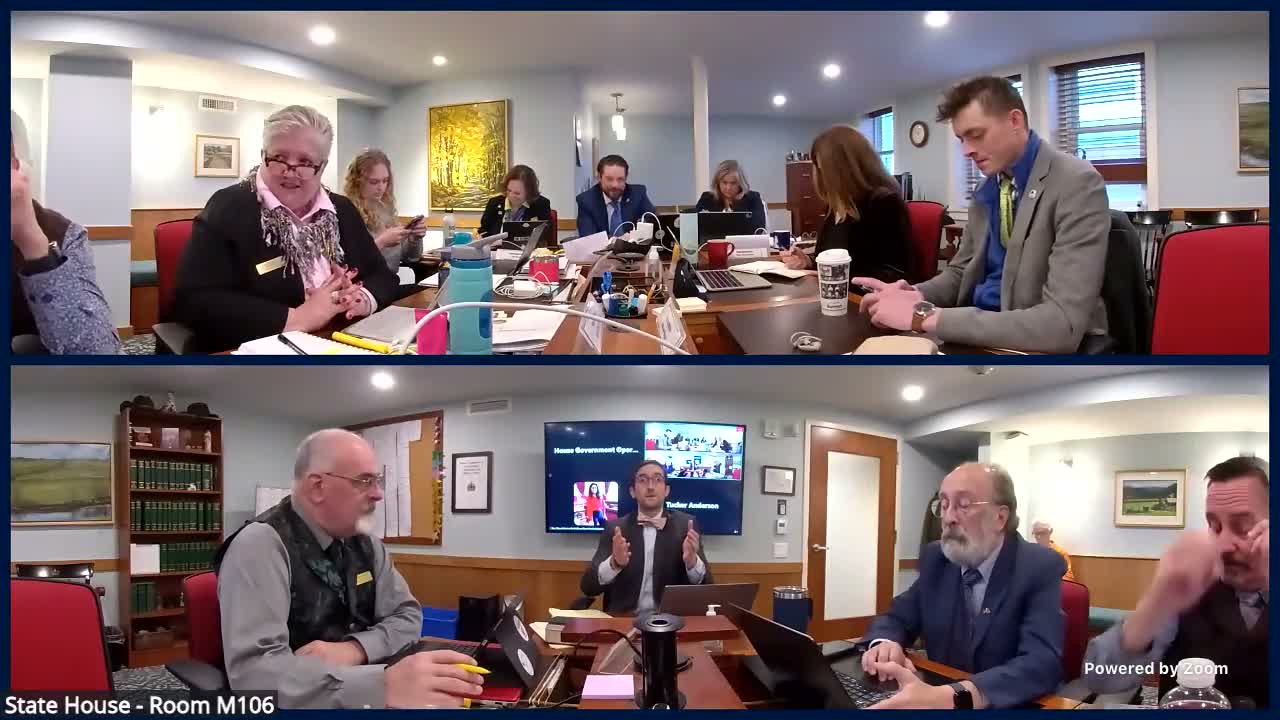
Summary
Legislative counsel briefed the Government Operations & Military Affairs committee on the Act 78 Public Safety Communications Task Force recommendations to establish a permanent board to oversee a statewide dispatch system, authorize rulemaking and a fee formula, and use prior appropriations and pilot funds to support transition.
Tucker Anderson, legislative counsel, told the Government Operations & Military Affairs committee that the Act 78 Public Safety Communications Task Force has asked the Legislature to authorize creation of an indefinite board to oversee a statewide public safety communications system and to grant the body rulemaking authority and funding tools to modernize dispatch services.
The recommendations, submitted to the General Assembly on Jan. 14, would let the board set minimum technical and operational standards for dispatch centers, standardize training and certification, and promote regional cross‑coverage to address staffing shortfalls, Anderson said. The task force also proposed adoption of uniform computer‑aided dispatch systems, interoperability with geographic information systems, expanded use of RapidSOS and other public alerting tools, and upgrades to land mobile radio infrastructure.
Why it matters: supporters say the state’s current dispatch system is fragmented and unevenly funded, producing disparities in service and coverage. Anderson summarized how prior appropriations would support a transition: $11,000,000 was appropriated to the Department of Public Safety in 2022 for regional dispatch funding; Act 78 (2023) made up to $1,000,000 available for technical experts; the Joint Fiscal Committee was authorized to approve up to an additional $1,000,000; up to $4,500,000 was earmarked for pilot projects; and the report urged the department to pursue $9,000,000 in congressionally directed spending to aid a modernized regional communications network.
Key details and unresolved questions: the task force did not specify the new board’s composition or appointing authority, Anderson said, leaving the committee to decide how many members the board should have, who would chair it and which offices would make appointments. The report also recommends a dispatch‑fee assessment to sustain operations after three years of initial funding, but Anderson said it is not yet clear whether fees would be collected by the board, by the Department of Public Safety, or routed through the general fund — a policy choice the committee would need to resolve.
An unnamed committee member described the current landscape as "very unequal across the state," noting that some municipalities now pay nothing for dispatch while others shoulder significant costs. Committee members pressed on equity and governance questions, including whether the goal is a single statewide dispatch center or a regionalized system that preserves local arrangements while standardizing service and funding.
Anderson emphasized that many recommendations look like rulemaking — for example, establishing uniform job classifications, a quality‑assurance process and an approved list of training programs leading to statewide certification — and that other items (best practices, templates) could be handled through guidance outside formal rulemaking.
The committee paused for a break after the briefing and will return to consider next steps, including whether to give the board authority to spend funds currently held in reserve for task‑force activities and how to craft statutory language covering membership, fee structure and the transition from the task force to a standing board.