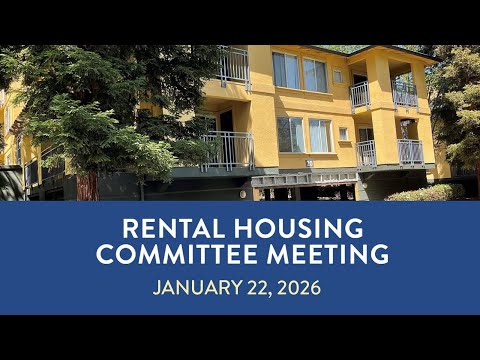
Committee hears wide-ranging California landlord-tenant law update including SB 707 remote-attendance rules and AB 246 tenant-defense
Loading...
Summary
Staff briefed the committee on SB 707 changes to remote attendance under the Brown Act and multiple landlord-tenant statutes and recent appellate decisions, and answered committee questions about applicability and unresolved statutory language.
On Jan. 22 the Rental Housing Committee received a detailed briefing on recent California legislation and court decisions affecting landlords, tenants and mobile-home residents.
City staff summarized SB 707 changes to the Brown Act, telling the committee that remote attendance rules have been consolidated into a single "just cause" category for committees and that remote participants must use both audio and visual. "There is only 1 reason, it's just cause," a staff presenter said while explaining the new framework and limits on just-cause attendance.
The staff update covered multiple statutory changes that affect mobile homes, disaster response, security deposits and eviction procedure. Among items discussed were AB 456 (timelines and deemed approvals for mobile-home-sale/occupancy notices), AB 806 (requirements that park management allow cooling systems without extra charges), and SB 610 (tenant protections after disasters, including a tenant right to a refund of prepaid rent and landlord responsibility to remove debris until a public-health determination is made). Staff noted SB 610’s debris provisions apply only where a disaster is declared by the governor or the president.
Staff also explained AB 246, the Social Security Tenant Protection Act, which "authorizes tenants in California to assert a Social Security hardship as an affirmative defense to an unlawful detainer," according to the presentation. Under that statute, if tenants can show benefits were terminated or delayed through no fault of their own and that the hardship prevented payment, a court must delay proceedings (up to the earlier of 14 days after benefits are restored or six months) and may dismiss or set aside judgments if tenants repay or enter into an agreed payment plan.
Other changes summarized included amendments to security-deposit procedures (default electronic or mailed-return methods when applicable), an expansion of language access through a mandatory multilingual unlawful-detainer summons, and a law affecting when hotel/motel occupancy may be treated as tenancy for certain purposes. Staff also reviewed recent appellate rulings, including the Court of Appeal’s decision in California Apartment Association v. City of Pasadena (which upheld much of Pasadena’s charter amendment but found two provisions preempted) and Admirals Cove LLC v. City of Alameda (which left rehabilitated former Navy housing subject to local rent stabilization).
Committee members raised detailed legal questions: Vice Chair Cox and others sought clarification on AB 628 (the refrigerator/stove provisions) and whether those rules apply to month-to-month or renewed rent-controlled tenancies; staff said statutory language was unclear in parts and that some questions will likely require judicial interpretation. Members also asked whether the Pasadena holding affects the city’s local ordinance; staff said they are "looking into that." No formal action was taken; staff will keep the committee informed of developments while noting some items (for example, court review requests) remain pending.
The briefing is for information; staff highlighted that some statutory provisions (including those that depend on public-health determinations) contain implementation details that could limit or expand tenant remedies depending on subsequent agency determinations or judicial rulings.