Get Full Government Meeting Transcripts, Videos, & Alerts Forever!
Get email alerts on the Rent Stabilization topic
No spam. Unsubscribe anytime.
Mountain View holds Spanish-language tenant workshop on rent-stabilization and eviction protections
Summary
City staff held a Spanish-language workshop outlining Mountain View's rent-stabilization measure, the nine 'just-cause' eviction reasons, notice timelines (3-, 30-, 60-, 120-day windows), mediation and legal referrals, and how tenants can respond to unlawful-detainer filings.
Mountain View city staff led a Spanish-language workshop explaining tenant rights under the city's rent-stabilization measure and related state rules, and described steps tenants can take when they receive a termination notice.
Rosario, the Spanish-language presenter, said the voter-approved rent-stabilization measure (referred to in the presentation as CSFRA/CFRA) is intended to stabilize rents, limit rent increases and protect tenants from unlawful evictions. She said most rental units built before Dec. 23, 2016 are covered for rent stabilization; units built before 1995 and not public or subsidized are fully covered for both rent stabilization and eviction protections, while units built between 1995 and 2017 may be partially covered for eviction protections only.
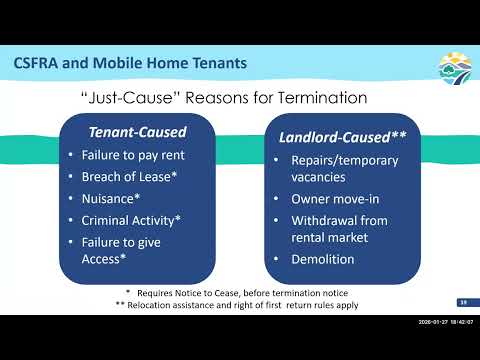
The presenter said the local rules and state mobilehome residency law limit evictions to nine 'just causes'. Tenant-caused reasons listed in the workshop include nonpayment of rent, lease violations, substantial nuisance, criminal activity and failure to provide access. Owner-caused reasons include temporary vacancy for repairs, an owner move-in, permanent withdrawal of the unit from the rental market and demolition. Rosario stressed that refusing to sign a new lease is not by itself a just-cause reason to evict and that existing lease terms remain in force unless otherwise specified.
Rosario reviewed notice requirements in detail. She said landlords must serve a termination notice that specifies the just-cause reason and whether the unit is covered by the city measure or mobile-home rules. For nonpayment of rent, a landlord may serve a three-day pay-or-quit termination notice and is not required to issue a prior notice to cease; landlords must file copies of termination and eviction notices with the Rent Stabilization Division and, according to the presentation, that filing must occur within three days and an unlawful-detainer filing must be served within seven days. Rosario said tenants can use the landlord's failure to file a copy with the city as a defense and urged tenants to contact the Rent Stabilization Division promptly if they receive a termination notice to explore options for delaying or challenging an eviction.
The workshop outlined additional protections for units removed from the rental market: owners doing substantial remodeling that removes units from the market must provide relocation assistance to eligible tenants and give 120 days' notice (and up to one year's notice if the tenant is elderly or disabled), as described in the materials.
Rosario also explained the unlawful-detainer (eviction) court process: complaint and summons, generally 10 days to respond, time to gather evidence and a hearing; if a tenant fails to respond the court may enter a default judgment. She advised that responding within 10 days is critical and that tenants should collect and submit required forms and documents so the court can consider defenses.
The city detailed referral options and help available to tenants: the Housing Help Clinic (held the first and third Thursdays, 6-8 p.m., at an Escuela Avenue address in Mountain View), a free city mediation program described as confidential and successful, and referrals to legal aid organizations and court help. The presenter named Community Legal Services of East Palo Alto (CLSEPA), Bay Area Legal Aid, the Santa Clara Bar Association, The Loft Foundation and the Superior Court help center as places that may be able to assist. She said the city can refer callers to the Help Center if a first-line provider cannot help.
Rosario encouraged attendees not to panic on receiving a termination notice, reminded them that staff cannot provide legal advice but can provide information and referrals, and said the presentation would be recorded and that slides and resource contacts would be emailed to attendees. She closed by asking participants to complete a follow-up survey and announced the next Housing Help Clinic date.
The session did not record any formal votes or motions; it was an informational presentation with an attendee question about eligibility for assistance that the presenter answered by describing income-based or eligibility review by the referral programs.