
Benton County commissioners press Great River Regional Library on $6,624 cut and ask for detailed spending breakdown
Get AI-powered insights, summaries, and transcripts
Subscribe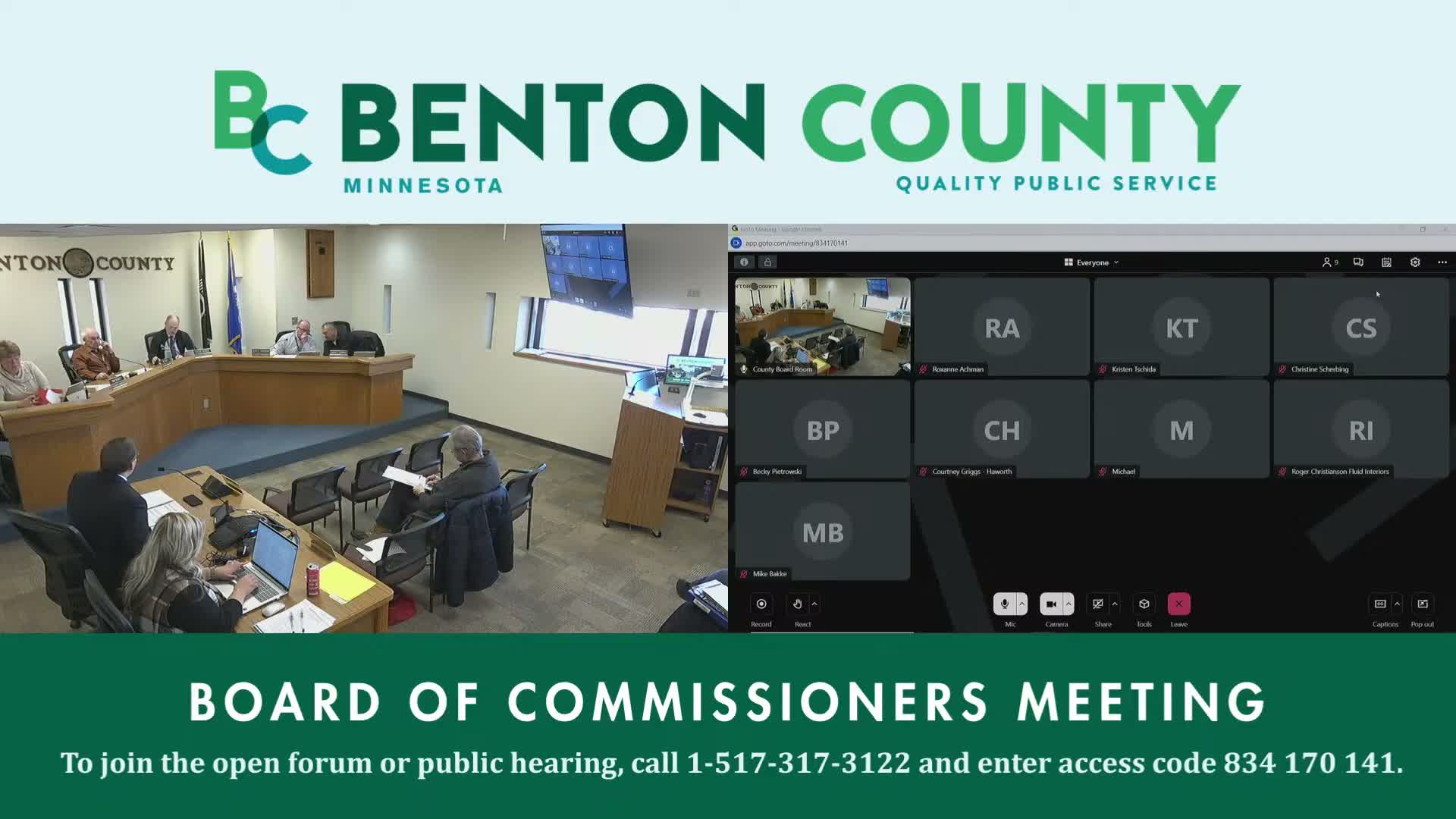
Summary
Great River Regional Library executive director Brandy Kanter asked Benton County to restore a $6,624 reduction in the county's 2026 contribution; commissioners pushed for a detailed county-by-county and per-library cost breakdown and questioned the equity of the regional funding formula.
Brandy Kanter, the new executive director of the Great River Regional Library, asked the Benton County Board of Commissioners on the record to reconsider the county's proposed cut to its 2026 library contribution and to provide more detail about how regional funds are used. "The budget for Great River Regional Library for 2026 was approved in July," Kanter said, noting Benton County was listed as providing $546,670 but the library system had proposed $540,046, a $6,624 difference.
Kanter told the board the library's funding formula uses population, borrower counts and net tax capacity to allocate costs across six member counties, and described a floating collection that gives all counties access to the same materials. She also said borrower totals have been rising: "In 2023, it was under 6,000, and as of January 1 this year, it was 6,600." Kanter acknowledged that a portion of Benton residents use neighboring libraries and said she can prepare a more detailed breakout for the commissioners.
Commissioners pressed for more transparency and local impact data. Several members noted Benton County has one physical library (Foley) but pays roughly $540,000 into the regional system, while larger counties with multiple branches appear to receive more direct service. Commissioner Burdine asked for a detailed accounting of where the county's payment goes, noting that Foley staffing is about $95,000 a year and "to take that $6,600 out of that, I don't know, it ends up being 3 to 5 hours a week, probably."
Kanter said the library system maintains investments and reserves used to offset county contributions; she estimated the system's fund balance at "around 7 to 8,000,000 right now" but said much of that is invested and not liquid. She also emphasized that the state sets a maintenance-of-effort (MOE) baseline that affects regional funding rules and that the shared-service model limits options for isolating county-level cuts without affecting services across the region.
Several commissioners asked staff to request a county-by-county and per-library operating-cost breakdown from Great River Regional Library and to seek clarification from the regional finance committee about how reductions would be allocated across member counties. Commissioners expressed frustration at having a single vote on the regional finance committee while bearing a sizable portion of the system cost and asked Kanter to return with a more granular report.
The board did not change its vote at the meeting; commissioners agreed to gather additional data and to raise the issue with the library executive and finance committees. The library presentation prompted members to discuss whether Benton should press the regional board to split certain costs differently or to seek other structural changes to the joint powers agreement.
Next steps: staff will request a detailed breakout of expenses from Great River Regional Library (per-county and per-library operating costs, staffing and capital allocations) and Kanter said she will share that information with the commissioners and the full regional board.