Get Full Government Meeting Transcripts, Videos, & Alerts Forever!
Get email alerts on the Personnel Policy topic
No spam. Unsubscribe anytime.
Jersey Village council debates vacation and sick‑leave payouts, asks staff for comprehensive review
Summary
Councilmembers spent the bulk of a special meeting debating whether the city's vacation and sick‑leave payout rules create an uncovered budget liability, with one councilmember citing a compensated‑absence liability of about $895,001.75 and the body directing staff to return with options including a contingency reserve and a comprehensive compensation review.
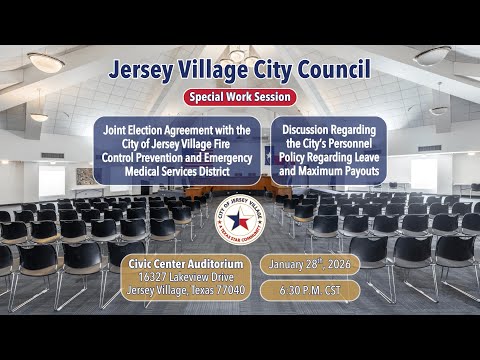
Speaker 1, a councilmember, opened a lengthy discussion of the city personnel policy covering vacation and sick‑leave accruals and payouts after two large recent employee payouts prompted a budget amendment. "09/30/2024, that number was $895,000," Speaker 1 said when citing the city's audited compensated‑absence liability, later giving a more precise figure of $895,001.75 and noting the two recent payouts represented roughly 13% of that balance.
Several councilmembers and staff described how current policy works: typical vacation accrual examples were cited (80 hours for 0–2 years, 120 for 3–5 years, 160 for 10+ years), and speakers repeatedly noted a 200‑hour cap used in payout calculations. Speaker 2 argued the city should discourage treating vacation as a savings account and recommended limits on rollover or accruals to incentivize employees to take leave: "The reason you have vacation is to encourage your employees," Speaker 2 said. Other councilmembers pushed back that benefits and culture contribute to retention and that the city is generally competitive: "We're competitive with other cities," Speaker 5 said, and others stressed that long‑service employees had earned the payouts.
The council focused on two principal responses rather than immediate policy change: (1) budget protection by establishing a contingency/reserve line to cover a portion of compensated‑absence liability and (2) a directed staff review of the total compensation picture (salary plus benefits) to produce better city‑by‑city comparisons and cost estimates for potential policy changes. Speaker 1 proposed modeling a reserve similar to the city's building replacement reserve and suggested funding a percentage of the liability annually as a buffer; examples discussed ranged from a modest 5% ($45,000, per Speaker 1's quick example) up to 20% as a policy choice.
Councilmembers also discussed operational issues and exceptions: department differences (police/fire/public works shift patterns), the effect of anniversary dates on displayed accruals, and existing leave donation policies that have been used in past cases. Staff (Speaker 3) confirmed the city permits employees to donate leave to coworkers in serious need; Speaker 3 said the policy has been used "twice."
No formal policy change or ordinance was adopted at the meeting. Instead, the council agreed to have staff refine the data and present options timed to the next budget cycle, and to explore whether an outside consultant or RFQ for a compensation/total‑rewards study would be appropriate.