
Mesa officials cite 2025 drops in violent crime, credit proactive policing and tech investments
Get AI-powered insights, summaries, and transcripts
Subscribe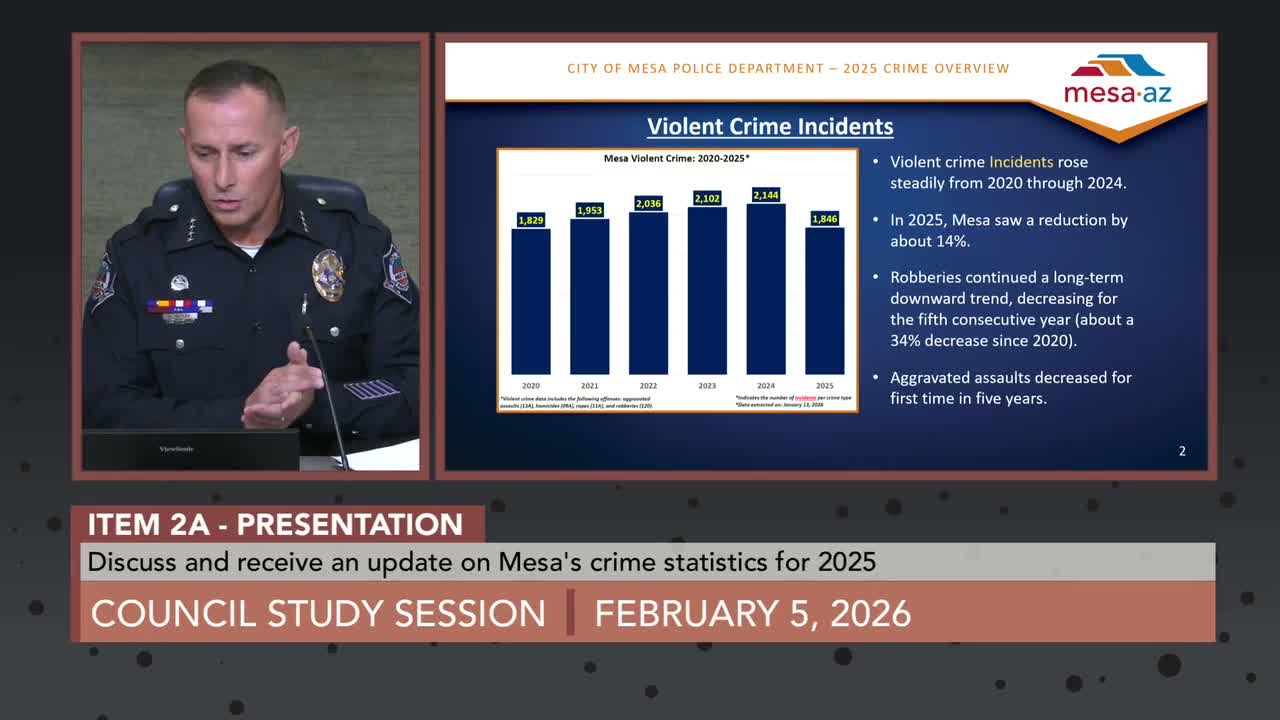
Summary
Police Chief Dan Butler told the City Council that Mesa saw a 14% reduction in violent crime in 2025, with notable declines in robberies and aggravated assaults; staff said increases in detected human‑trafficking and weapons violations reflect proactive investigations, not necessarily more victims.
Police Chief Dan Butler told the Mesa City Council on Feb. 5 that the city saw a 14% reduction in violent crime in 2025 and credited a combination of proactive policing, community engagement and technology for the decline.
"What we saw in 2025 was a reduction," Butler said, describing year‑over‑year declines in robberies (down about 14%) and aggravated assaults. He said the department is approaching a 90% clearance rate on serious investigations and noted the national average is about 50%.
The department's presentation, led by Butler and assistant chief (Chief of Staff) Nesbitt, outlined several operational changes. Calls for service rose roughly 5% in 2025—reflecting population growth—while dispatch calls declined about 4% and officer‑initiated (proactive) contacts increased nearly 18% from 2024 and about 60% since 2021. Staff said mission‑directed patrols more than doubled in 2025 (from about 13,000 to 29,000 occurrences), a 113% increase.
Nesbitt and other presenters said the department has expanded traffic enforcement and added six officers to the traffic unit in January to address an uptick in traffic collisions and to reduce fatalities. Traffic citations and warnings rose by more than 20% as part of that strategy.
The presentation also highlighted areas of increased detection. Reported human‑trafficking offenses rose from 33 in 2024 to 61 in 2025—an 85% increase. "This is just a more proactive way to address this crime and put a dent into what is happening," Nesbitt said, adding the increase reflects targeted investigations that uncovered previously unreported offenses rather than a clear rise in victims.
Light‑rail‑adjacent incidents also received attention: staff reported roughly 1,500 incidents near light‑rail stops in 2025 out of about 1.8 million rides, and noted that Mesa officers handled about half of those incidents. Butler said that ratio equates to an incident rate of about 0.08% of rides.
Council members asked about community concerns related to immigration enforcement and federal agents. Council member Duff and others sought reassurance that Mesa officers do not ask about immigration status during proactive contacts. Butler responded that Mesa does not conduct immigration‑status questioning in the field and that the department does not enforce federal immigration law in the field. He referenced Arizona Revised Statute 11‑1051 when describing notification practices, saying federal notifications occur only after lawful arrests for criminal offenses as allowed by state law.
Council praised the department's community outreach efforts, including community action officers (CAOs), and several members emphasized that the department's approach—blending sworn officers with civilian specialists and technology such as the real‑time crime center—has improved outcomes.
The presentation closed with city leaders thanking police leadership and staff; there were no formal council actions tied directly to the presentation during the session.
Next steps: staff will return to council with routine briefings as needed and continue to report crime‑trend data at upcoming meetings.