Get Full Government Meeting Transcripts, Videos, & Alerts Forever!
Get email alerts on the Freedom West EIR topic
No spam. Unsubscribe anytime.
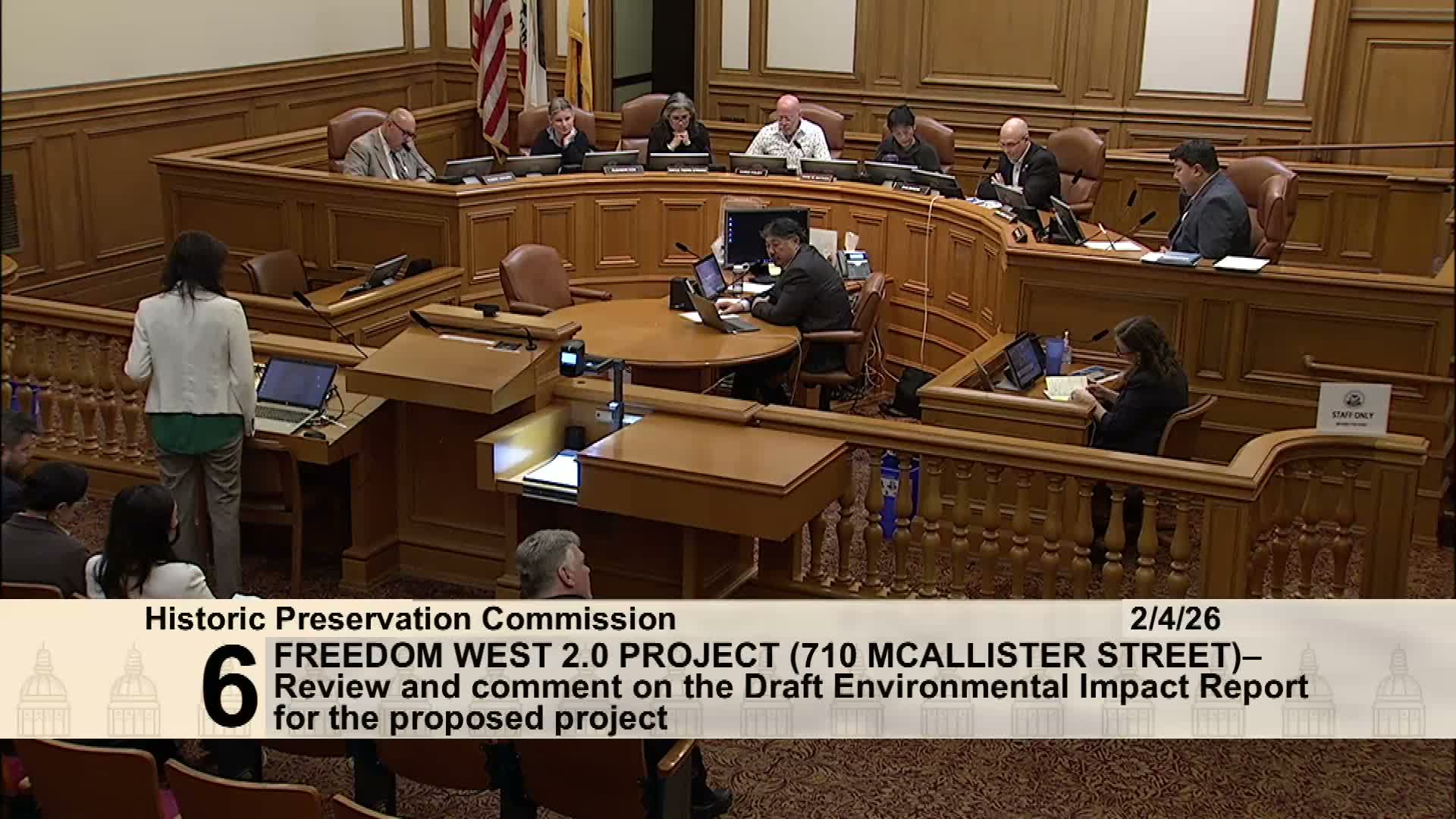
Commission reviews Freedom West 2 draft EIR, hears co-op leaders urge approval
Summary
Planning staff briefed the Historic Preservation Commission on the Freedom West 2 draft EIR and preservation alternatives; co-op residents and board leaders spoke in support, and commissioners pushed for stronger mitigation, expanded archival repositories, and clarity on whether displaced residents with preference certificates may return.
The San Francisco Historic Preservation Commission reviewed the draft environmental impact report for the Freedom West 2 project and heard public testimony from Freedom West leaders who said the EIR faithfully reflects the project and community process.
Planning staffer Justin Greving presented the draft EIR for the Freedom West complex in the Western Addition, noting the public review period is open through Feb. 27, 2026, and asking the commission to comment on the EIR’s identification of historic resources, impact analysis, mitigation measures and range of preservation alternatives. Staff said Freedom West — a 22‑building co‑op developed between 1972 and 1975 in partnership with Bethel AME Church and led originally by Reverend J. Austell Hall — is individually eligible for the California Register for its association with redevelopment and as a co‑op. The draft EIR describes a proposed project that would demolish existing buildings and construct new buildings across the site; staff outlined four preservation alternatives (no project, full preservation, and two partial preservation options) and described mitigation approaches such as documentation, oral histories and interpretive programs.
Michelle Brown, a Freedom West resident and board member, told the commission the EIR is “accurate and complete,” emphasized the co‑op’s 382 households and Bethel AME’s $10 million commitment to revitalization, and urged the commission to allow the project to move forward so construction can begin and residents can return. Maddie Scott, Freedom West board president and a resident for more than 50 years, described an extensive community‑led process — “40 plus community meetings” and a supermajority co‑op vote — and said the plan includes a relocation program intended to allow shareholders in good standing to return.
Commissioners questioned staff about mitigation details and repositories for documentary materials. Commissioner Cox asked why the Library of Congress was not listed as a repository in mitigation measure cultural resource documentation; staff said repository suggestions could be included in an HPC comment letter. Commissioners pressed for mitigation stronger than an interpretive program — proposing tangible interpretive panels and other durable documentation — and asked whether displaced residents in the original A2 area with certificates of preference would be eligible to participate in the reconstituted co‑op; planning staff said that question is best addressed by the project sponsor at the Planning Commission hearing on Feb. 12.
The commission did not vote on the EIR at this meeting; staff reminded the commissioners that any HPC comment letter would inform the administrative record and might be addressed in the EIR’s response‑to‑comments document prepared for the planning commission’s public hearing.