Villa Rica council hears Safe Streets plan; places adoption on next meeting’s consent agenda
Loading...
Summary
Consultants presented a Safe Streets and Roads for All Safety Action Plan summarizing 12 months of data and stakeholder input, highlighting a high‑injury network and targets to reduce serious injuries; council agreed to place formal adoption on next Tuesday’s consent agenda.
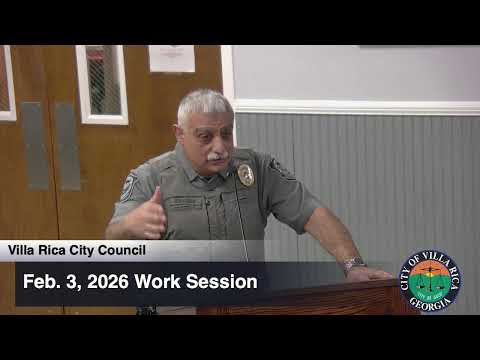
Clay Smith, project manager for the city’s Safe Streets consultants, and Alex Simmons, deputy project manager, presented a high‑level summary of a 700‑page Safety Action Plan to the Villa Rica mayor and council on Feb. 3. The plan, prepared under a Safe Streets and Roads for All grant, analyzes crash data, identifies a high‑injury network and recommends tiered projects and countermeasures prioritized by readiness, benefit‑cost and equity.
The consultants said the plan draws on 12 months of stakeholder meetings and public surveys and uses both crash records and community reports of near misses. "We're not gonna go through every page of that 700‑page document," Smith said, noting the presentation condensed the material to key findings. Alex Simmons reported that GDOT data show 1,026 total crashes in Villa Rica in 2025 and that over a five‑year period (2020–2024) the city recorded more than 4,000 crashes with 11 fatalities and 73 serious injuries.
The plan recommends a safe‑systems approach and five emphasis areas: safer road users, safer vehicles, safe speeds, safe roads and post‑crash care, and applies the "5 E's"—engineering, education, emergency medical response, enforcement and equity—when selecting countermeasures. Simmons said a high‑injury network of routes and intersections accounts for a majority of crashes and roughly 91% of fatal and serious‑injury crashes, making it the primary focus for near‑term projects.
Consultants described a scoring matrix that balances fatality risk, serious‑injury frequency and local priorities so that both large‑scale and low‑cost countermeasures can be advanced. They urged annual reporting tied to crash data and recordkeeping to measure outcomes and said implementation grants will be pursued for larger projects.
During council discussion, members raised concerns about newly opened bypass sections and a small local roundabout (Pumpkintown/Punkintown), asking whether the plan can address emerging issues sooner than the five‑year update. The consultants recommended applying the plan’s risk scoring proactively and leveraging GDOT peer‑review contracts where state routes are involved.
The chair moved to place the Safety Action Plan on next Tuesday’s consent agenda for formal adoption; no council member opposed placing it on consent. Formal adoption was not completed at the Feb. 3 work session and will be recorded at the subsequent meeting if approved.