
RSU 05 superintendent recommends middle-tier 7% budget amid enrollment decline; staffing cuts targeted to secondary schools
Get AI-powered insights, summaries, and transcripts
Subscribe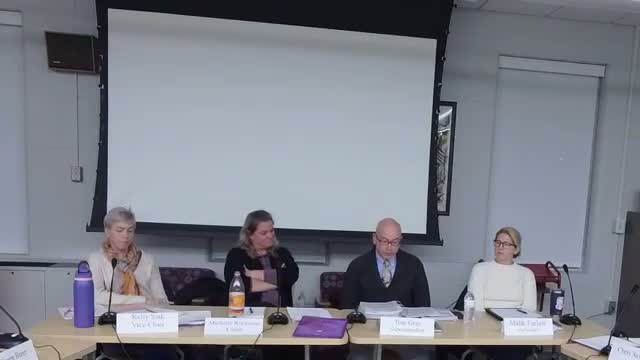
Summary
Superintendent Gray presented three budget tiers for 2026–27 and recommended a middle option (about 7%) that reduces some staff positions—focused mainly at middle and high school levels—while preserving core elementary class sizes and special-education services.
Superintendent Gray on Wednesday presented a three-tier proposed 2026–27 budget to the RSU 05 board, recommending the middle option (about a 7% increase) as the best balance to preserve core programs while addressing rising fixed costs.
Gray said a status-quo budget would be “just over 10%” and stressed staffing accounts for roughly 80% of district spending, so achieving lower increases requires strategic reductions. The superintendent outlined $807,000 in items the board has already voted to carry forward and $154,818 in recommended additions that administrators believe are important to sustain programming.
Gray described three tiers the board requested in November — roughly 6%, 7% and 8% — but said the figures presented are slightly under those percentages to leave room for the pending state subsidy. He noted the district’s total budget is about $40 million, meaning roughly $400,000 equals 1% of the budget. To reach the lower tiers, administrators identified a mix of nonstaff reductions (deferred painting and carpeting, delayed device replacement) and targeted staffing changes.
At the recommended tier, proposed personnel impacts concentrate at the middle and high school levels: a reduction in some unified-arts and language positions at Freeport Middle School while shifting world-language exposure to a single daily language, and reductions in the high-school math and world-language staffing mix that administrators said would preserve offerings while bringing department sizes into alignment with enrollment. Districtwide ESOL staffing was also flagged for adjustment to reflect declining multilingual enrollment.
Gray emphasized the proposal aims to “keep intact our core programming” and maintain class-size guidelines in elementary schools. He told the board that deferring hard decisions carries cost: “If we defer hard decisions now, it means harder decisions later.”
Administrators said some recommended additions — a small summer-school allocation (~$7,000), a $2,400 stipend for middle-school swimming, facility-study funding (to be offset by capital reserve), and a reallocation that would create a half-time transportation administrative assistant while reducing a half-time central office bookkeeping position — are either small in the overall budget or budget neutral.
The superintendent also reiterated that early-childhood cohort 3 remains unresolved because state guidance and final allocation amounts are still incoming. He said Deputy Commissioner Megan Welter had indicated the district should expect about half the funds originally requested and noted that a commitment to join cohort 3 would likely be required by early March.
What’s next: board members asked for more granular impact analyses — especially detailed schedule and staffing effects at Freeport Middle School and projected class-size changes for affected courses. Administrators said they will return with more information at upcoming budget meetings and with community-program and nutrition details in a follow-up session.