Flagstaff fire team details treatments, home-hardening and insurance challenges; ISO rating could help lower premiums
Loading...
Summary
Flagstaff Fire Department described engineering and prescribed fire work around the city, home-assessment tools and WUI code updates, and said aligning statewide mitigation standards with insurers and an improved ISO rating could affect premiums and development.
"Our risk isn't just drawn on a map or the line," Fire Captain Dylan Howe told the council as he described Flagstaff City's approach to wildfire risk reduction, which combines landscape treatments, home-level work and community education.
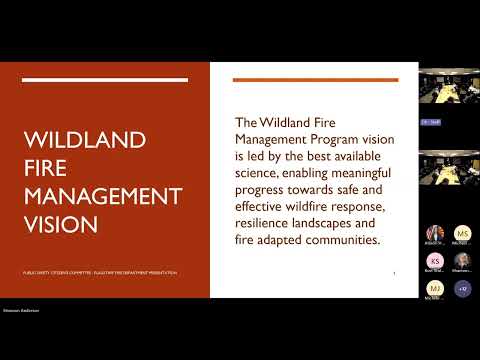
Howe and other fire officials walked the council through the "5 E's" of the city's strategy: enforcing science-based codes, engineering natural and built environments, improving emergency response, educating homeowners, and supporting economic incentives to scale mitigation. They showed before-and-after photos and video from prescribed burns and described mechanical thinning followed by pile burns and later broadcast prescribed fire as common tactics.
The team highlighted parcel-level tools: the WUI app used during driveway assessments to collect data and create follow-up reports, and proposed WUI code updates that staff say could incorporate Insurance Institute for Business & Home Safety (IBHS) standards. Staff said they will study the cost impact on affordable housing before proposing mandatory changes to construction materials.
Insurance and monitoring issues were front-and-center. Officials said homeowners who complete mitigation work can still face nonrenewal because insurers' risk models are not yet aligned with parcel-level mitigation data. "We need an agreed-upon mitigation program," Howe said, outlining three needs: a statewide set of mitigations insurers recognize, a monitoring system to confirm maintenance, and incentives for homeowners.
Kyle Denham, deputy chief over community risk data, explained the Insurance Services Office (ISO) municipal rating, noting Flagstaff received a citywide ISO 2 in 2021 but areas outside city limits have weaker ratings due to water-supply and response factors. Denham said a better ISO rating can give insurers more confidence, potentially reducing premiums and aiding economic development.
Why it matters: staff argued that combining engineered forest treatments (the "donut" of treated lands around Flagstaff City), parcel-level home-hardening and better insurer alignment is necessary to reduce wildfire pathways into neighborhoods and to maintain insurability for homeowners and businesses.
Next steps: staff will continue code updates, pursue statewide mitigation-recognition frameworks, expand home-assessment outreach, and work with partners to build monitoring and data-sharing systems to link parcel mitigation to insurer models.