
Flagstaff staff warn rising utility, pension and maintenance costs as personnel gaps grow
Get AI-powered insights, summaries, and transcripts
Subscribe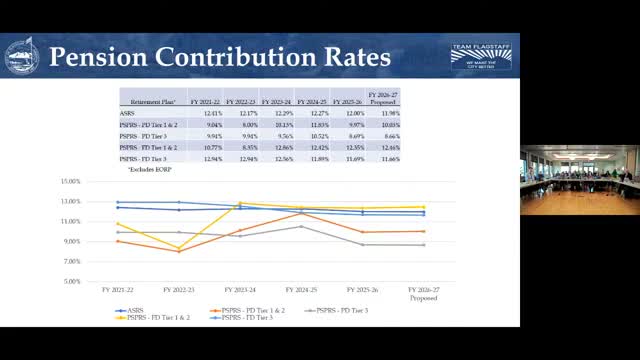
Summary
At the Feb. 5 budget retreat, staff said pension funding has stabilized but rising electricity bills, vehicle-maintenance costs and growing maintenance obligations from new infrastructure are straining funds; staff cited fixed-cost pressure and an identified need for additional personnel, especially in public safety and code compliance.
City staff told the Feb. 5 budget retreat that while pension funding has stabilized, a convergence of rising utility costs, vehicle parts and new maintenance obligations is increasing pressure on Flagstaff's operating budgets and staffing.
Heidi (budget staff) reported that pension contribution rates have largely steadied since the city paid down a PSPRS-related liability; the large one-time PSPRS payment in 2024 ($3.2 million) boosted funding stability and staff projected only a modest pension increase (~$121,000) for FY27 tied to salary growth. But staff warned fixed costs are trending up: electricity could be roughly $1.6 million over adopted budget across city accounts in FY26 and non-water electricity projections used in staff's FY27 planning show double-digit percentage increases in some scenarios.
Nicole Antonoffa, sustainability director, said the earlier Noresco energy-efficiency project helped buffer previous rate increases and "essentially the work that we did save the city money" by absorbing prior APS rate impacts. She cautioned, however, that the city is not yet fully electrified and water services remain the organization's largest electricity user; electrification increases can raise exposure to future electricity-rate changes if efficiency gains are insufficient.
Staff also highlighted operational and personnel pressures. Code compliance averages more than 160 cases per month with two officers, driven by short-term rentals, snow/sidewalk clearing and property-care enforcement, and staff urged adding capacity. On public safety, staff identified roughly 149 positions needed across police, fire, ARFF and emergency management to meet growth that has already occurred, not to accommodate new future programs.
Infrastructure maintenance from recent capital projects (new courthouse, roundabouts, street widening) has introduced recurring custodial, HVAC and landscape costs that were not always budgeted into initial CIP proposals; staff said they are beginning to build maintenance obligations into project budgeting and to consider dedicated vegetation/public-works crews to manage medians and plantings.
Council and staff agreed personnel reviews and rate studies for user fees (parks, solid-waste, airport landing fees) are part of the toolbox to address ongoing costs, with division-level reviews starting immediately and proposals returning to council at the April retreat.
"We are seeing some savings, but if APS keeps bumping rates up, it takes away from the gains that we would have," Nicole said, summarizing the trade-off between electrification and exposure to utility-rate changes.
Staff will return to council with personnel-request reviews, rate-study timelines and concrete budget recommendations at the April retreat.