
Firefighting Commission debates training standards, course approvals and textbook choices
Get AI-powered insights, summaries, and transcripts
Subscribe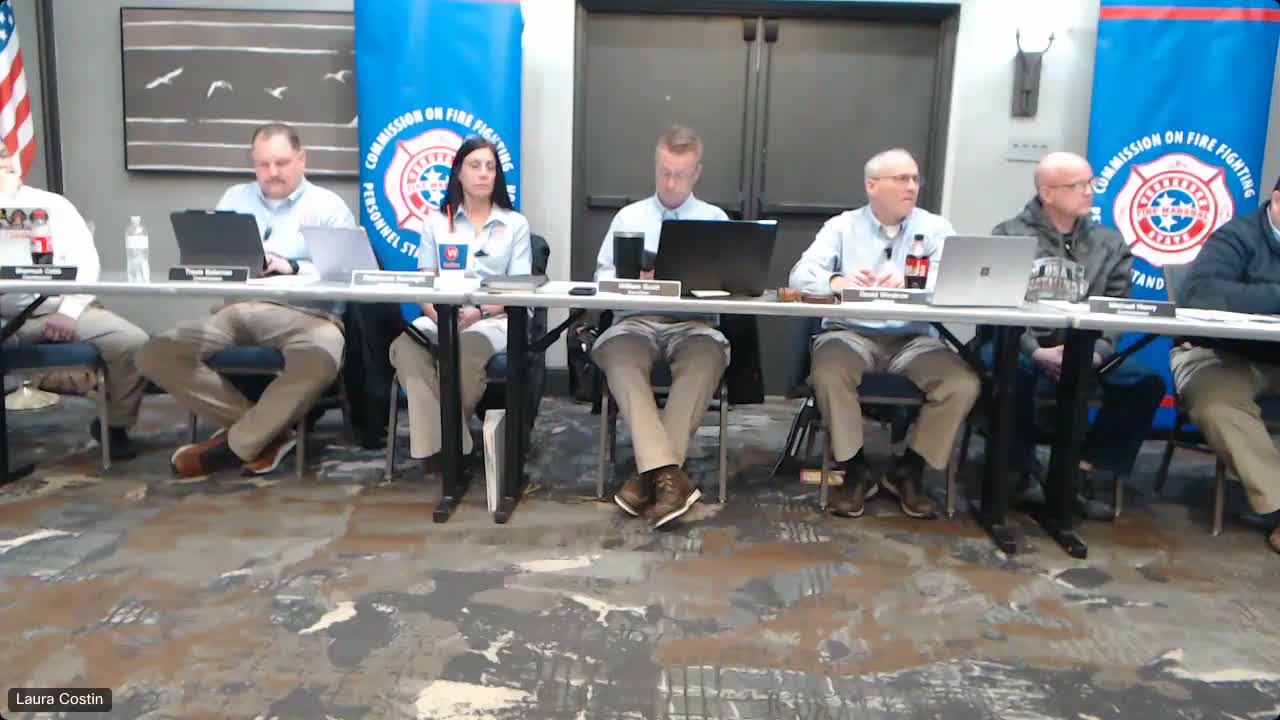
Summary
At a Feb. 3 work session, the Firefighting Commission confronted conflicts between rule chapters and NFPA standards over which classes qualify candidates to test for Firefighter 1, warned that inconsistent approvals risk accreditation, and advanced a subcommittee recommendation on textbooks to be voted on at the next meeting.
The Firefighting Commission opened its Feb. 3 work session in Jackson with a broad review of training and certification practices, centering on whether short ‘‘16/64’’ live‑burn programs satisfy prerequisites for Firefighter 1 testing and how the commission should reconcile differences between chapter 2 and chapter 3 of its rules.
Commission staff and members flagged a large group of legacy certifications and gaps in documentation. "We found 3,364 firefighters in the state that received their Firefighter 1 and 2 under the NFPA 1001 1997 addition that do not have hazard‑materials awareness or operations recorded," Speaker 2 said, adding that staff will upload a validated memo to the Cadence personnel system so affected members can access proof while staff review course correlations.
Why it matters: Commissioners said the commission’s accrediting body requires demonstration that candidates were trained to the job performance requirements (JPRs) before evaluation. Several speakers warned that approving courses without correlation sheets or without enforcing chapter 3 standards could jeopardize statewide accreditation. "If we allow someone to get Firefighter 1 who has not met the JPRs, we're putting everybody’s accreditation at risk," Speaker 1 said.
Discussion and proposals: Commissioners debated whether the 16/64 live‑burn plus local training should remain an acceptable route to the Firefighter 1 written test or whether the commission should require fuller course submissions that explicitly map each JPR to course content. Speaker 6 proposed the commission require all basic firefighting courses to be resubmitted and approved under current NFPA JPRs effective July 1, 2026 (a later proposal discussed 01/01/2027 as an alternative deadline). Commissioners asked staff to draft a compliance roadmap and to allow a transition period so volunteer departments are not unduly burdened.
Textbooks and validation: A subcommittee recommended that Jones & Bartlett be accepted as the primary textbook for Firefighter 1 and 2 and that IFSTA be accepted for several operator curricula; Speaker 2 said the committee will place the recommendation as a formal motion at the next meeting for a vote. Commission members emphasized that test‑bank validation and content review will need to continue if a new core text is adopted.
Training administration: The commission discussed strengthening attestation and in‑house evaluator programs so that departments document practical skill completion while a course runs instead of relying on post hoc affidavits. Speaker 2 said the commission will ask departments to submit correlation sheets with course requests and to include practical skill‑sheet attestations for each candidate.
Next steps: The commission placed the subcommittee textbook recommendation on the next meeting’s motion list and asked staff to prepare draft rule language and an implementation timeline for course resubmission and for communicating correlation requirements to departments. No final rule changes or binding votes were taken at the work session.
Ending note: Commissioners agreed to keep volunteer training access in mind when setting deadlines and to provide clearer guidance through the Cadence system and revised rule language.