Get Full Government Meeting Transcripts, Videos, & Alerts Forever!
Get email alerts on the Levy Delivery topic
No spam. Unsubscribe anytime.
SDOT outlines 2026 levy delivery plan, cites about 430 levy‑funded starts and tighter summer constraints
Summary
SDOT told the Steps Committee it expects roughly 430 named levy‑funded projects to start planning, design or construction in 2026, highlighted hiring and a new dashboard, and flagged scheduling limits during Revive I‑5 work and the FIFA World Cup.
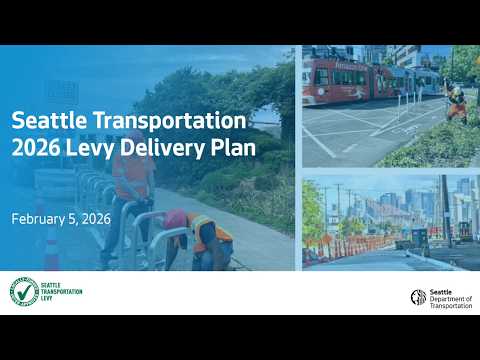
SDOT briefed the Seattle Steps Committee on its proposed 2026 levy delivery plan on Feb. 5, laying out program priorities, staffing and a schedule constrained by regional construction events.
The presentation said the 2026 plan includes "approximately 430 projects across all 7 council districts" that will begin planning, design or construction and that the levy portfolio was appropriated about $190,000,000 in the 2026 budget. SDOT staff also pointed to a new public dashboard and a planned April 2026 map of completed work to increase transparency.
Why it matters: The levy is intended to fund both small neighborhood safety projects and larger, multi‑year corridor and bridge work. The committee framed the briefing as a governance check aimed at improving early oversight and ensuring a strong start to levy delivery after voters approved the $1,550,000,000 levy package.
SDOT highlighted near‑term accomplishments and staffing. "We were able to hire 50 new positions in 2025 to support overall levy delivery," Serena Lehman, Levy Manager, said during the presentation. Staff said some positions remain in the hiring pipeline and additional hires authorized by council are still being filled.
The department said it is sequencing work to avoid major construction conflicts during two large city events: the Revive I‑5 project and the FIFA World Cup this summer. "There’s gonna be some constraints on where we can do work in our streets, especially during our dry months," an SDOT speaker said, and the department said it will prioritize projects that can be completed or advanced with minimal disruption.
Council members pressed SDOT on several implementation issues: how hiring shortfalls affect delivery, when the low‑pollution neighborhoods list will be finalized, how freight projects will coordinate with port and regional partners, and how the department balances in‑house crews versus contracted work. SDOT said it is using a mix of in‑house delivery and consultants for surge needs and that projects over a defined threshold include community workforce agreements for contractor work.
Other items discussed included: - District Project Fund: SDOT said $2,000,000 of levy money is allocated to a District Project Fund for 2026, and council members were reminded to submit district project ideas by March 1. - Pothole response: The council noted an internal service‑level pledge to repair 80% of reported potholes within 72 hours; the chair reported SDOT delivered 90% within that window in practice. - Project sequencing and community impacts: SDOT emphasized early coordination to avoid "construction fatigue" where multiple projects overlap in the same neighborhood.
Next steps: SDOT will brief the levy oversight committee in March and publish its 2025 annual report that month; the department plans quarterly reporting for 2026, with the first quarterly report due in May.