
PGCPS board adopts virtual education day plan and approves calendar change, removes Presidents' Day as makeup option
Get AI-powered insights, summaries, and transcripts
Subscribe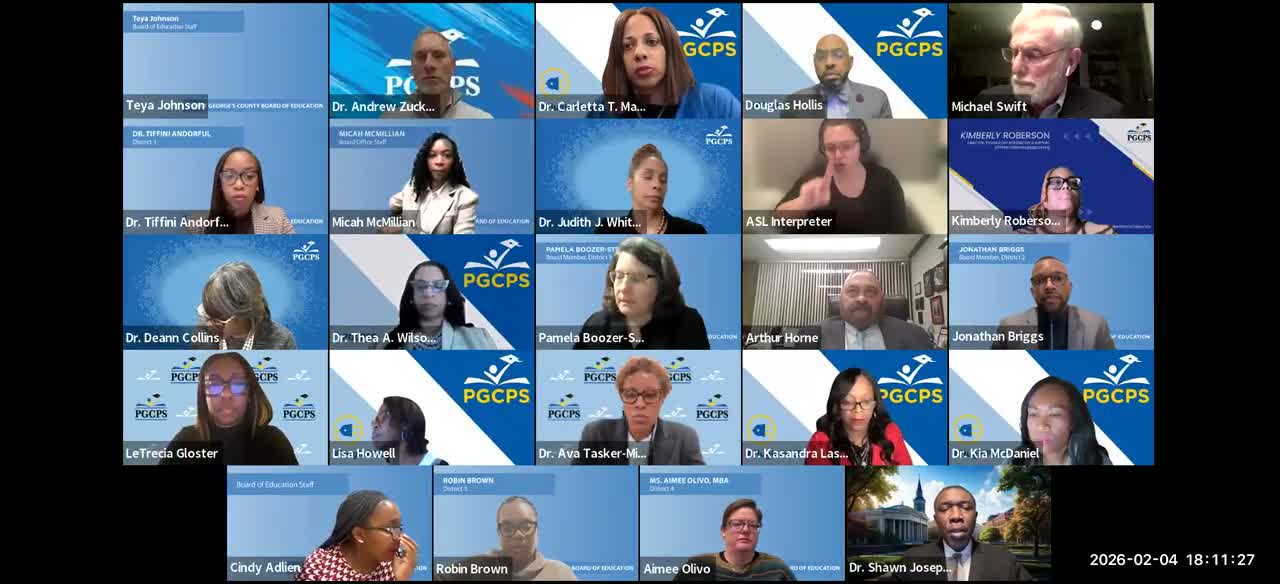
Summary
The Prince George's County Board of Education approved a virtual education day plan that requires at least four hours of synchronous instruction and authorized calendar adjustments to add June 18 and a post‑Easter day as potential makeup options, removing Presidents' Day from consideration.
Prince George's County's Board of Education on Feb. 4 adopted a virtual education day plan aimed at preserving continuity of instruction during extreme weather and authorized changes to the 2025–26 calendar while removing Presidents' Day as a makeup option.
The board, convening in an emergency virtual meeting, approved item 5.1 — the virtual education plan — without objection. The plan requires a minimum of four hours of synchronous instruction on any day declared a virtual education day, follows recent changes in Maryland law, and includes device- and equity-focused provisions, administration officials said.
"A virtual education day now had to be a minimum of 4 hours of synchronous instruction," Chief Information Officer Andrew Zuckerman told the board as he explained the legal change and the operational requirements it imposes. Zuckerman said the statutory change for the 2024–25 school year means the district must ensure live instruction, attendance tracking in Synergy and supports for students with IEPs and multilingual learners.
The plan details how teachers and students will access instruction: Canvas will be the district's learning-management system accessed through Clever; live instruction will use Google Meet embedded in Canvas; attendance from live sessions will be recorded and integrated into Synergy. Kimberly Robertson, director of technology integration, said the district will allow families to request devices through ParentVUE and deploy limited spare inventories and emergency charger kits to schools.
Public commenters expressed mixed views. Leslie Brooks, a parent from Capitol Heights Elementary, urged more decentralized authority for school leaders, clearer contingency plans, predictable transitions to virtual after consecutive snow days and flexible attendance policies. One parent asked the board not to label absences "unexcused" when calendar changes force families to miss makeup days; another speaker, Thomas Fedrodi, opposed virtual learning and cited learning-loss concerns from the pandemic.
Administration and board members discussed operational tradeoffs, equity and special-education continuity. The district said it has retained a limited number of hotspots since the pandemic and has distributed chargers and other supplies; staff also said about 6,000 hotspots were acquired during the pandemic but only about 187 were utilized at peak, a statistic speakers used to explain why the district will rely primarily on Chromebook inventories in schools.
On the calendar (agenda item 5.2), the administration asked the board for authorization to potentially use three days — Presidents' Day, the Monday after Easter and June 18 — to meet the state's 180-day requirement if necessary. Several board members and the administration said Presidents' Day is operationally infeasible to convert and recommended against using it. Board member Dr. Moss moved to approve the superintendent's recommendation while removing Presidents' Day; the board adopted the amendment and approved the calendar modification.
Chair Brandon Jackson closed the meeting after the votes and reminded the public the district would publish FAQs and resources and would continue work to refine operations and communication. The district plans drills and training for teachers and principals and will publish an information page with resources for families by the following Friday, officials said.
What happens next: the district will implement the plan operationally, continue targeted outreach to families who lack devices or ParentVUE access, refine guidance for IEP/504 service delivery on virtual days and pursue state waivers where appropriate to limit calendar impacts. The board also scheduled a first virtual budget work session the following day.