Get Full Government Meeting Transcripts, Videos, & Alerts Forever!
Get email alerts on the Education Budget topic
No spam. Unsubscribe anytime.
Tolland Board Advances 7.9% Budget Scenario After Night of Deep Cuts and Difficult Choices
Summary
After a line-by-line review of superintendent Walt Willett’s FY27 scenarios, the Tolland Board of Education voted to advance a 7.9% BOE budget scenario and a package of reductions to present to the town council, while asking the council to consider funding school security and technology as capital items.
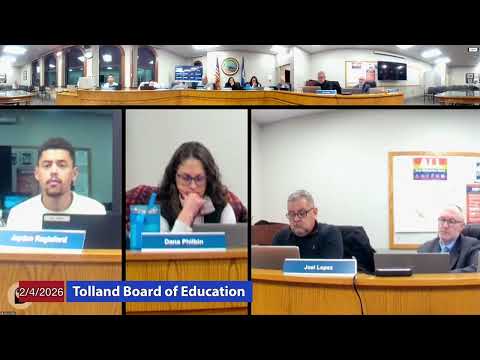
The Tolland School District Board of Education advanced a 7.9% budget scenario on Feb. 4 after a nearly eight-hour special meeting during which the superintendent walked members through three reduction iterations and the board took votes on dozens of individual line items.
Dr. Walt Willett, the district superintendent, told members the goal of the session was to be prepared to adopt a budget at the board’s Feb. 11 meeting and forward it to the town by the statutory deadline. He said he prepared three alternatives — a 7%, 5% and 4% scenario — and that each percentage point of reduction is roughly worth $450,000. “If you go from a 7 to a 4, you’re looking at $1.2 to $1.3 million,” Willett said as he explained the spreadsheet the board used to move items into a ‘customized’ reductions column.
The largest personnel protections were directed by the board. Willett said the 7% scenario would preserve the district’s staffing structure while adding a social worker and a PPT facilitator; lower-percentage scenarios progressively remove or reassign positions. He cautioned that a 4% target would require cuts to non‑retiree teachers and materials and said, “I would rather have that than lose people” — a phrase he used several times to underscore the trade-off between staff reductions and operational disruptions.
Transportation emerged as one of the most contested topics. Board members pressed Willett on the operational impact of removing two additional buses (on top of prior reductions). Willett said shrinking the fleet — currently down six buses from earlier contract levels — would lengthen routes, force frequent ‘combining’ of runs, increase afternoon disruptions and shift staff from instructional leadership to constant triage. He said two more buses removed would “make daily work even harder” but would not immediately push the district below legal thresholds for transportation services; it would, however, increase complaints and administrative burden.
Athletics and extracurriculars were another flash point. Willett’s materials showed the district-funded portion of high‑school athletics at roughly $583,000; he said fully parent-funded athletics would create per-family costs comparable to travel-team fees and could run into the hundreds or even more than $1,000 per athlete in some sports. Board members discussed fundraising models, higher pay‑to‑play fees and family caps; one proposal to raise certain high‑school pay‑to‑play fees by $100 (to increase revenue roughly $45,000) was debated but not broadly adopted as a primary solution.
Special-education outplacement and transportation set‑asides also influenced voting. Willett warned that some reductions would remove safety margins currently held for unexpected outplacement costs and special‑ed transport. On several reduction lines the superintendent noted a trade-off: removing a reserve for an outplacement would force the district to absorb those costs elsewhere if a student required an expensive placement.
Board members asked for and received additional historical context: Willett said the district’s long‑run average budget increase is roughly 1.6% (11‑year average), that the superintendent’s initial proposals average about 4.5%, and that cumulative underfunding versus a 3% path over a decade could be on the order of millions. He urged members to use dashboard working documents and the FY27 FAQ he posted to review specifics before the next meeting.
After a methodical line‑by‑line process that placed chosen reductions into the working ‘customized’ column, board member Mackenzie moved — and the board seconded — a motion to prepare the assembled 7.9% scenario and related reductions as the BOE package to present to the town council and to bring back a finalized adopted budget at the Feb. 11 meeting. The motion passed by voice vote. The board asked Willett to request the town council consider taking the district’s security and technology upgrade requests as capital items; those requests remain contingent on the town council’s decision.
What’s next: the board will review the final draft at its Feb. 11 meeting and vote on the adopted BOE budget that will be forwarded to the town. If the town council declines to take on any of the security/technology capital asks, the board may need to revisit the reductions.
Quote highlights from the meeting: Willett warned of the operational effects of additional cuts: “If we reduce 2 more buses, I think…you’re going to start seeing things come into the board’s email now,” and later, “I would rather have that than lose people.” On athletics, he said the fully parent‑funded option would mean families could face costs ‘‘like a travel team’’ and cautioned the board against relying on one‑time community donations as a sustainable funding source.
The board adjourned at about 11:50 p.m.