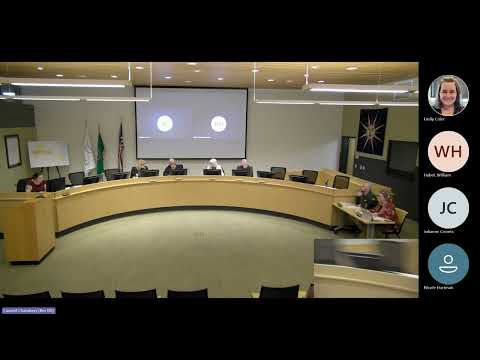
Sequim planning commission adopts draft supplemental housing code ahead of full zoning rewrite; public hearing set Feb. 17
Loading...
Summary
The Sequim Planning Commission reviewed proposed supplemental housing-code updates to align local rules with recent Washington state housing legislation, covering ADU limits and sizes, parking changes, supportive and temporary religious housing rules, and a process for affordable-housing exceptions; a public hearing is scheduled for Feb. 17.
The Sequim Planning Commission on Feb. 3 reviewed a draft of supplemental housing requirements that staff says are necessary to implement recent Washington state housing laws and to prepare for a full rewrite of the zoning code later this year.
Staff member Travis told commissioners the updates are intended to align the city's development code with state statutes, provide clearer definitions for housing types and to put in place processes for items the state now requires.
The draft addresses several state-driven changes and some local policy choices. Among the key provisions, the draft would: require single-family lots to allow up to two accessory dwelling units (ADUs) with newly capped sizes for new ADUs at 1,000 square feet; allow conversions of existing spaces (basements, garages) to exceed that cap; adopt state minimums for residential parking (including exemptions for ADUs within a set transit radius) and locally remove parking requirements for permanent supportive housing; permit supportive housing where hotels and motels are allowed while holding density caps in the R-48 zone; codify a state process for temporary housing on religious properties with a required memorandum of understanding and background checks; and create a conditional-use pathway for alternative development-standard exceptions for qualifying affordable-housing projects.
"We have these requirements from the state," Travis said, noting staff's goal is to get these changes on the books "now" rather than waiting for the full Title 18 rewrite planned with the comprehensive plan later in the year. He said the draft uses RCW language where possible to reduce ambiguity in definitions.
During public comment, Sequim resident and general contractor Brad Griffith urged the commission to consider very small, satellite living units he calls "Lighthouse Shelters," describing them as "small, permanent shelters about the size of a bedroom" with power but no water and an estimated engineering cost of about $6,000. Griffith said those units cannot meet the state energy code under current standards and asked the commission to consider "downsizing to satellite bedrooms" as a planning option. Staff responded that state energy codes set minimums and that some jurisdictions have developed permitting approaches for temporary or nonstandard structures, but that allowing permanent, lower-standard dwelling units would require a deliberate local approach or a state exception.
Commissioners asked staff to clarify several points in the draft. One commissioner asked whether "co-living" units would include bathrooms and kitchens; staff said co-living is envisioned as shared services similar to a dormitory or hostel and would be flexible depending on the proposal. Commissioners also raised the geographic basis for low-income definitions; staff said the Housing Needs Assessment uses Clallam County area median income (AMI) references and agreed to refine the definitions so they are consistent.
On ADUs, staff said new detached or attached ADUs would generally be capped at 1,000 square feet while conversions of existing space could be larger. ADUs would not count toward density in most cases, but unit-lot subdivisions could change how density is applied. For parking, staff noted cities can choose between several state options (for example, 1 space per unit or 1 space per bedroom) and said Sequim would largely retain existing parking requirements for now but remove requirements for permanent supportive housing.
The draft also addresses common-interest communities (CICs) and ADU restrictions. Staff said the RCW prevents jurisdictions from allowing CICs formed after July 23, 2023, to prohibit ADUs that are otherwise allowed by state law and that the city is not responsible if a permit conflicts with CC&Rs; staff recommended advising applicants to verify CC&Rs.
Staff proposed a local application process to authorize alternative development standards for qualifying affordable-housing projects (nonprofits, subsidy providers, housing authorities), likely via a conditional use permit with City Council as the ultimate review authority for exceptions.
For temporary housing on religious properties — a state-mandated allowance — staff said the code establishes a process and MOU requirements (including applicant-provided background-check procedures and coordination among city staff, the managing agency and the fire district). The draft also proposes allowing a permanent density bonus for affordable housing on religious properties; staff recommended a 25% bonus and stressed units must be deed-restricted affordable, not market-rate.
Travis summarized that many elements of the draft are required by the state while others are local choices made where the law permits flexibility. The Planning Commission was told staff will not meet Feb. 10 and that a public hearing on Title 17 and Chapter 18.21 is scheduled for Feb. 17; staff will then present the Commission's redline comprehensive-plan materials to City Council as part of the broader zoning update.
The Commission approved minutes earlier in the meeting and adjourned after a motion to adjourn.