
UVM agronomist outlines how USDA, NRCS define "prime" farmland and how Vermont maps local importance
Get AI-powered insights, summaries, and transcripts
Subscribe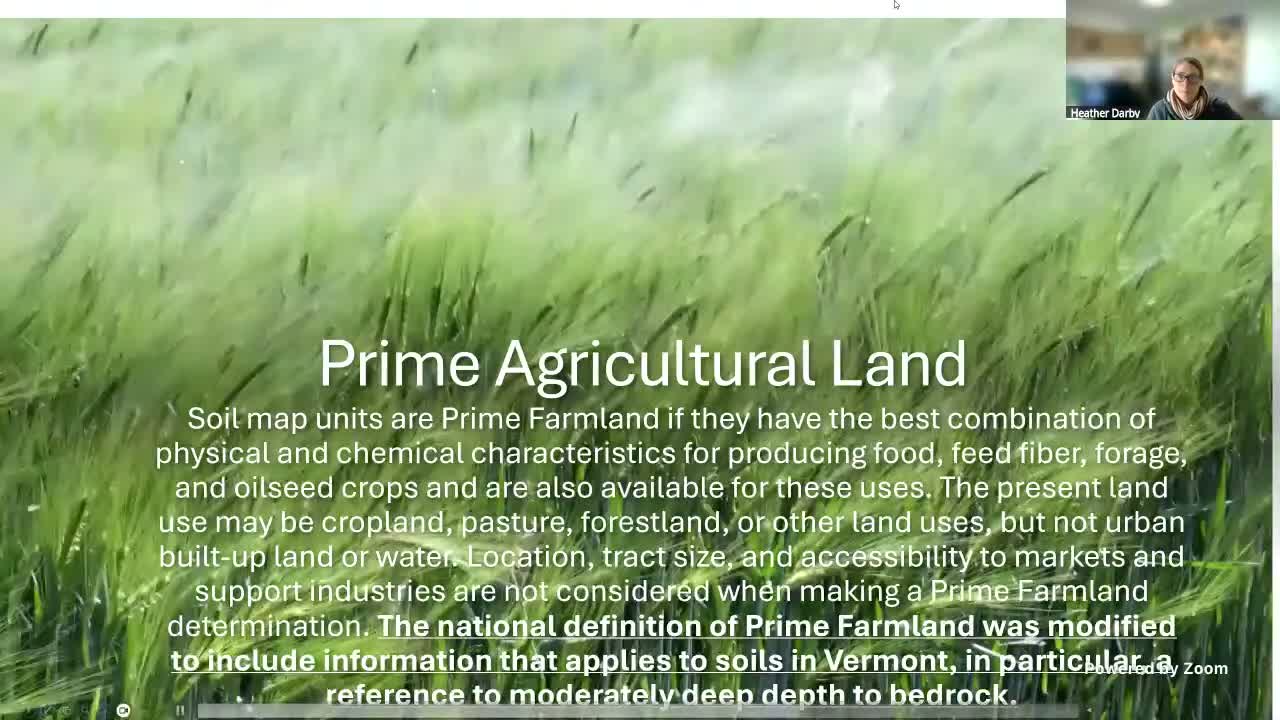
Summary
Heather Darby of University of Vermont Extension told legislators that USDA/NRCS definitions identify soils best suited to food, feed and fiber production; she explained federal thresholds (depth, slope, flooding), how states designate soils of statewide or local importance and where to find parcel-level maps.
Heather Darby, an agronomist and soil specialist with the University of Vermont Extension, gave members of the Agriculture, Food Resiliency, & Forestry panel an overview of how the U.S. Department of Agriculture’s Natural Resources Conservation Service defines and maps "prime" agricultural soils and how Vermont supplements that framework for state and local priorities.
"Knowing that we have land that can do that is at the core, of national security," Darby said, describing the original purpose of the federal classification: to identify soils best suited for producing food, forage, fiber and oilseed. She emphasized the classifications reflect inherent soil characteristics — not simply how a parcel is being managed.
Darby told legislators the NRCS and USDA maintain national soil surveys and mapping tools, including the Web Soil Survey, which allow users to zoom to town and parcel level and see whether a soil unit is labeled prime, statewide importance or local importance. She said the federal prime designation typically reflects several traits: loamy texture, higher organic matter, good drainage, little rock, depth to bedrock (deep often >40 inches; moderately deep 20–40 inches) and generally gentle slopes (commonly <8 percent).
The presenter clarified how flooding and slope affect federal designation. Soils that are frequently flooded — Darby said "more than two years in a row on average" during the growing season — generally are not classified as federal prime farmland but may be designated as soils of statewide importance. Likewise, steeper fields commonly used for pasture or hay in Vermont may be ineligible for the federal prime label even when they are productive at the local level.
Several legislators pressed on reclassification and local decision-making. Darby said NRCS regularly updates surveys but that reclassifying a soil unit because of short-term management (for example, adding a few inches of topsoil) is not how the federal system operates: "No — because we have to think about — management plays a huge role in how productive a soil is regardless of how prime it is," she said. Local actors such as conservation districts can recommend soils of local importance, but Darby said formal concurrence for designation comes from the NRCS state conservationist.
Representative Nelson raised examples from the Winooski River Valley, noting highly productive floodplain soils that still flood seasonally. Darby told the panel such soils could be designated statewide importance rather than federal prime if flooding frequency meets the exclusion criteria. On development pressures, Darby acknowledged a tension: many soils best for farming are also convenient for building, and absent a viable farming community those lands can be sold for development.
Darby walked the panel through a mapping example in Grand Isle County, showing an "Amenia silt loam 0–3%" unit and the Web Soil Survey fields that record slope band, flood frequency, and whether the unit is marked prime or state importance. When asked who represents NRCS in Vermont, she named Travis Tomlinson Thomason as the state conservationist (also covering New Hampshire at the time of the meeting).
The presentation closed with an agreement to hear the Agency of Agriculture’s fuller briefing the following day and an invitation for Darby to return later in the spring for deeper discussion.
The panel did not take formal votes during the presentation; the session moved to a short break after the briefing.