
Land Use Review Board debates making forestry exempt like farming under Act 250; ANR input pending
Get AI-powered insights, summaries, and transcripts
Subscribe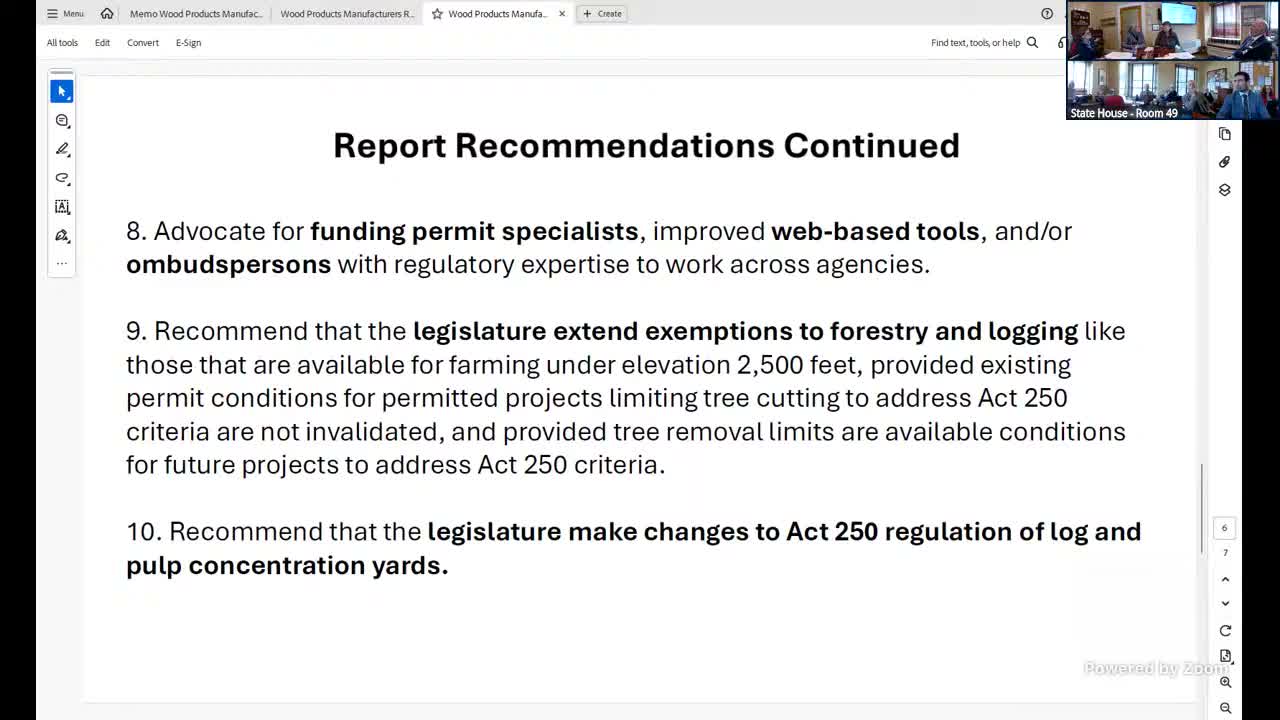
Summary
The Land Use Review Board reviewed draft language to extend farming‑style exemptions under Act 250 to forestry and logging below 2,500 feet, preserve existing permit conditions, and discussed whether to automate 'Stony Brook' parcel delineations; the board is awaiting Agency of Natural Resources feedback.
Janet Hurley, chair of the Land Use Review Board, told members the board would concentrate on recommendations 9 and 10 in draft language that would change how Act 250 treats forestry and logging.
"So recommend that the legislature extend exemptions to forestry and logging like those that are available for farming under 2,500 feet," Hurley read from the draft, adding that the change would preserve "existing permit conditions" and allow tree‑removal limits to remain conditions on future projects.
The proposal is intended to create parity between farming and forestry in statute. Kirsten, a board member, said the draft mirrors the farming language currently in statute so that land an applicant designates for logging or forestry management would be treated the same as land designated for farming "at least insofar as, at the time of application, they're designating as logging forestry management." She warned that certain permit conditions — for example, stream‑buffer requirements or protections for deer wintering areas — would still be enforceable: "You can't go in and log that area unless you return to Act 250 to get some revised relief," she said.
Board members discussed common scenarios that can trigger a return to the district commission. If a parcel has a sawmill and an Act 250 permit contains explicit restrictions on tree cutting, logging in those restricted areas would require a permit amendment or relief from the commission. The board also noted routine situations — such as storm damage or salvage operations — where accommodations are typically made to allow remedial tree removal when structures or property are threatened.
A separate point of debate centered on the "Stony Brook" concept, a procedural mechanism that lets applicants ask the commission to recognize a subset of a property as the area subject to Act 250 review. Kirsten described that process as document‑heavy and case‑specific: "It's complex, frankly ... you analyze all the criteria and what those impacts are, and then you have to go beyond that and think, consider, you know, then what is the area of land where that effect occurs?" She cautioned that making Stony Brook delineations automatic or standardized through statute could add substantial burden and would not suit the wide variation among parcels and projects.
The board also flagged Recommendation 10 as more straightforward: members discussed restoring log and pulp yards to their earlier classification as part of logging and forestry rather than as "wood products manufacturers," which would remove them from a narrower regulatory definition.
Several participants emphasized the draft language is not final. Board members and presenters said the text has not yet "received the benefit of input from ANR" and that the board would seek that feedback before moving forward. One staff member noted that the board could still turn the proposal into a bill and send it to the governor if the board chose to do so, but that step would follow any revisions and interagency review.
Next steps: presenters returned to the board with the draft for discussion, the board will solicit ANR guidance, and staff said they are developing additional guidance on road versus driveway thresholds that can trigger Act 250 review. No formal motion or vote was recorded on the draft language during this session.