
Researcher outlines Crete stable‑isotope baseline to help identify unidentified and migrant remains
Get AI-powered insights, summaries, and transcripts
Subscribe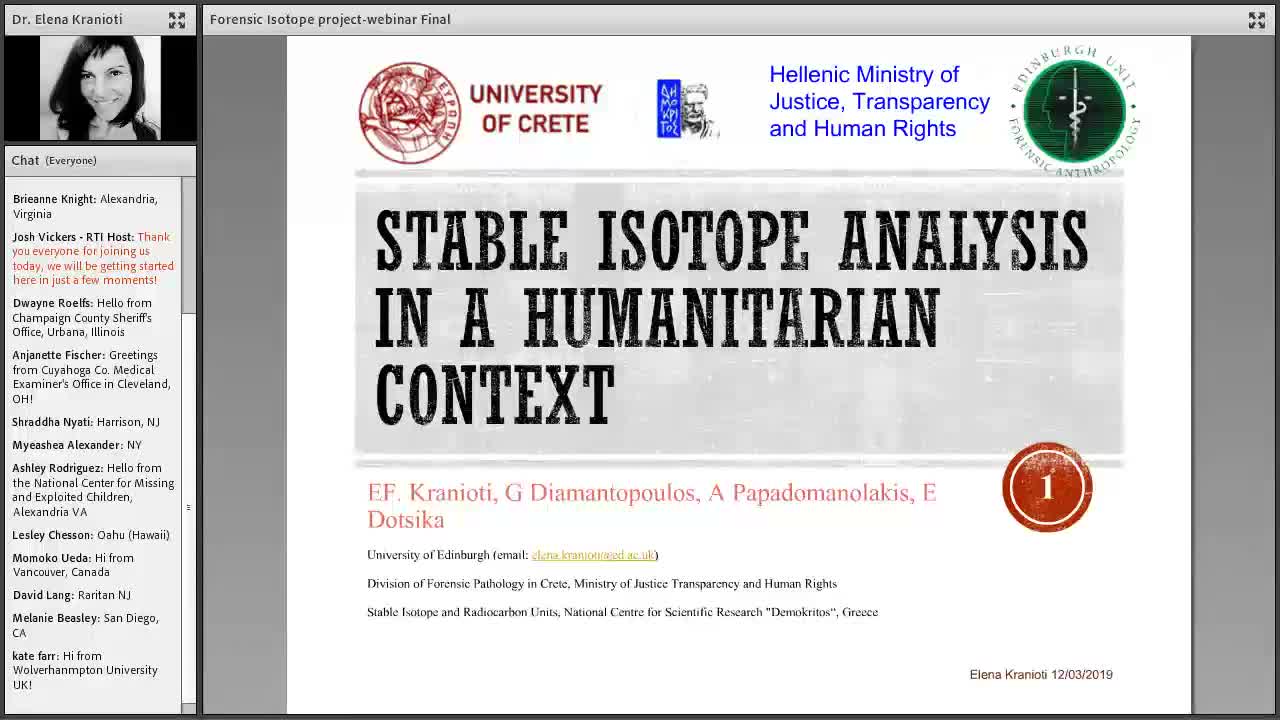
Summary
In a recorded webinar, Dr. Elena Krenjoti described a project to build the first stable‑isotope reference maps for Crete using bone, teeth, hair and environmental samples; preliminary isoscapes and sample counts were presented, and ethical approvals for minimal sampling of a local osteological collection were noted.
Dr. Elena Krenjoti presented a project to create a stable‑isotope baseline for the island of Crete intended to help forensic identification of unidentified and migrant remains. The project, she said, combines bone, teeth, hair and environmental samples and uses multiple isotopes (carbon, nitrogen, oxygen, sulfur, hydrogen, and sodium) to produce spatial “isoscapes” that can narrow probable regions of origin.
Krenjoti described the collaboration among the University of Crete, the University of Edinburgh, the Division of Forensic Pathology in Crete, and the stable‑isotope and radiocarbon units at the National Center for Scientific Research Democritus, and said funding came from the American Academy of Forensic Sciences Humanitarian and Human Rights Resource Center and the U.S. National Institute of Justice (NIJ). “So the project I’m gonna talk to you about today, it involves the use of isotopes for identification,” she said.
She reported substantially larger sampling than initially budgeted after collaboration with Democritus: the project used about 180 human bone samples (results for 56 analyzed so far), 15 teeth and hair samples, plus environmental sampling that included roughly 20 spring water samples, two bottled water samples, 11 rain samples, 20 soil samples and 10 animal samples. Krenjoti said those environmental data were used to build a spring‑water isoscape for Crete with oxygen values roughly −8 to −3.5 per mil and deuterium values roughly −48 to −15 per mil; tooth enamel oxygen values in the sample set ranged about −9.1 to −3.2 per mil.
Preliminary comparisons showed most modern local hair and bone values cluster with other European means but are distinct from several regions (for example, Finland, parts of Africa and some Indian regional means). One tooth outlier had isotopic values consistent with bottled water rather than local spring water, which Krenjoti cited as corroborating evidence that the person consumed nonlocal bottled water. She cautioned the results are preliminary and sample sizes for some isotope systems (including strontium) remain small.
Krenjoti also described biological patterns in the dataset: three older individuals with notably low nitrogen values had clinical records indicating cancer or cirrhosis; across the broader sample she observed a statistically significant trend of declining nitrogen values with increasing age (R² reported as 0.317), which she said merits further study and external validation.
On ethics and the use of the Cretan osteological collection, Krenjoti said the collection was assembled in 2005 from ossuary material after families stopped paying cemetery rental fees. To avoid destruction of remains she obtained “official approval from the local district attorney and the city hall approving the use of the material for research without informed consent,” and sampling was limited to small rib pieces in accordance with that agreement. She emphasized modern hair and tooth samples used for life‑history comparison were taken from living donors who consented.
Next steps she listed include expanding sampling (especially in western Crete), adding sulfur and sodium analyses, testing the database against forensic cases of known origin, creating a postmortem CT archive for unidentified individuals, and promoting local isotope capability at Democritus so analyses need not be outsourced. Krenjoti said she would share references and welcomed follow‑up questions via email. The host noted the webinar would be recorded and a PDF of the slide deck made available to attendees.