Get email alerts on the Post Election Audit topic
No spam. Unsubscribe anytime.
Ball State vSTOP outlines risk-limiting post-election audits to Monroe County election board
Summary
Matt Housley of Ball State University's vSTOP described risk-limiting audits for Indiana counties, explained the ballot-inventory and seed-drawing process, and urged unanimous board approval of a county resolution to request designation from the Secretary of State; no formal board vote on adoption occurred at this meeting.
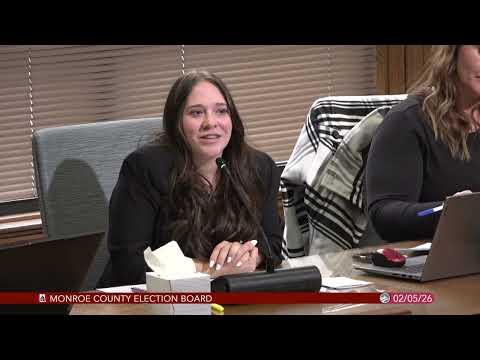
Matt Housley, election systems audit specialist with Ball State University's voting system technical oversight program (vSTOP), gave a public presentation to the Monroe County Election Board describing how post-election risk-limiting audits work and what the county would need to do to host one.
Housley told the board that vSTOP has conducted dozens of audits in Indiana and that the audits provide an independent, statistically rigorous check on whether reported outcomes were correctly tabulated. "We take a random sample of ballots, and we hand-tally the results until that sample gives us statistical evidence that the election outcome was correctly reported," Housley said. He described a publicly reproducible process for generating random seeds (he demonstrated rolling a 10-sided die to create a seed) and the "6-cut" method used to select ballots from boxes for inspection.
The presentation laid out key county responsibilities: preparing a complete ballot inventory (a count of ballots by box/precinct), making ballots available and sealed until the audit day for chain-of-custody, hosting a public seed-drawing, and accommodating auditors and tally teams on the audit day. Housley said vSTOP generally targets a 95% to 99% confidence level (1% to 5% risk), with the sample size driven by contest margins; closer races require larger samples. He noted vSTOP's audit tool is based on work by Philip Stark at UC Berkeley and emphasized the public and reproducible nature of the methodology.
Housley also described the procedural step counties must take: "The county election board is required to unanimously approve" a resolution requesting designation to have an audit performed; once adopted, vSTOP will send the county's paperwork to the Secretary of State for final approval. He said vSTOP will send a recommendation memo to the Secretary of State and that, if the county wishes to proceed, the board would adopt a resolution and vSTOP would return to conduct a pre-audit meeting and the audit.
Board members asked technical and logistical questions about sampling multiple contests on a single ballot, how sample sizes interact across contests, and the practical challenges of counting from boxes containing thousands of ballots; Housley walked the board through examples from St. Joseph County and other audits. He also said that auditors document any anomalies (for example, missing ballots in a selected box) in their written report, even when the anomaly does not change the audit's conclusion.
The presentation concluded with Housley offering brochures and a demonstration of the seed-drawing materials; no formal vote to adopt a resolution occurred at the meeting. Housley said he will follow up with a recommendation memo to the Secretary of State and with a draft county resolution should the board choose to pursue designation.
What happens next: vSTOP will send the recommendation memo and a draft resolution; the board would need a unanimous vote to request designation, after which the Secretary of State's office reviews the request and vSTOP would schedule audit dates and pre-audit planning.
Sources: presentation and Q&A by Matt Housley to the Monroe County Election Board.
AI generated
The text on this page is AI generated. Summaries, highlights, analysis, and video transcripts are all produced from the original source material.
AI can make mistakes, so if you spot one, and we will fix it for everyone.
Note: the source content is unaltered by us. Any content source we link to, be it a video, an audio recording, or a document, is presented exactly as its publisher released it. That publisher is usually a government body, sometimes an individual official or another organisation.