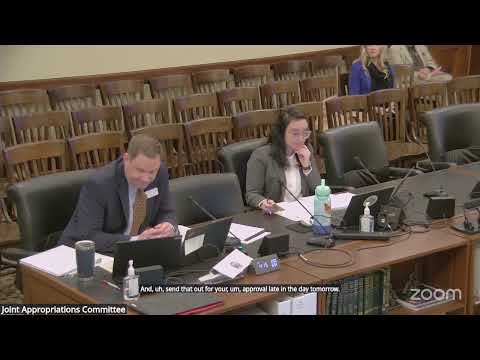
Joint Appropriations Committee advances budget packages, moves capital projects and adopts timing tweak to LSRA transfers
Loading...
Summary
The Joint Appropriations Committee advanced multiple budget bills and amendments, moving state capital construction projects into a separate bill, approving targeted funding additions — including $41.327 million for Indian Health Services — and adopting a budget‑balancer timing change intended to ease next‑biennium cash flow.
Cheyenne — The Wyoming Joint Appropriations Committee on [date not specified] advanced a set of budget and capital construction bills and approved several targeted changes intended to align agency funding with the committee’s priorities and cash‑flow projections.
LSO staff told members the committee’s capital construction projects were moved into a separate bill and that $332,141,925 previously identified in a CIP account would be reflected in the general fund for the capital package. "This comes in the amount of $332,141,925," the director said while introducing the capital construction draft, and staff flagged that major maintenance funding of $232,979,000 was relocated into the capital bill.
The committee finalized action on a narrower rural health transformation measure (working draft 0.7). LSO staff said the bill was pared back to focus on the federal Rural Health Transformation Program funds and that one of the larger amendments was "the removal of the telehealth services from the bill," a change that narrowed the short title to the Wyoming Rural Health Transformation Program. The committee took a vote to finalize the draft and left one or two remote votes open briefly for technical reasons before concluding the roll call.
A second major package, the committee’s biennial budget draft (26 LSO 0435, committee formal draft 1.1), reflected substantial net reductions from the governor’s recommendations offset in part by the capital construction bill. LSO staff said the committee reduced the governor’s recommendations by $314,400,000 while offsetting much of that by moving certain capital items into the separate capital bill.
Agency‑level adjustments and notable approvals - Department of Health: LSO recorded multiple footnotes and reductions, while the committee moved $344,000,000 of rural health transformation funding into the separate capital bill. The committee also approved an amendment to Unit 471 (Indian Health Services), adding $41,327,307 in federal funds after members said the department corrected its inflation estimate from roughly 10% down to 3%. Representative Pendergraft, who offered the motion, said "This ask is for 41,327,307." The motion passed on voice vote.
- University of Wyoming: The committee reduced the university’s state aid by $40,000,000 and debated a series of targeted protections. Representative Harrelson moved to add the Worth Institute and the High Bay project to a short list of items exempt from cuts; after debate over whether such carve‑outs amounted to "picking winners," the committee approved Harrelson’s motion to protect those two items.
- Department of Transportation: The committee added $5,000,000 to pay for increased compensation for highway maintenance and patrol personnel. Representative Nelson moved to change the funding source from general fund to S7 (highway fund) to align with current practice; the motion carried on a 7–5 vote.
- State Engineer / WaterOne items: Senator Larson secured a motion to move several small WaterOne charges (covering portions of compensation and a decades‑old endangered fish recovery commitment) from S1 special revenue to general funds; the motion passed by voice vote.
Procedural and programmatic changes LSO staff walked the committee through numerous footnotes and narrative sections. Key changes include a temporary reduction in the permanent trust spending policy rate (from 5% to 4.5% for the upcoming biennium), carryover and emergency authority for wildfire funds, and language authorizing specific ARPA‑funded positions to continue through set dates. Staff also described a business‑relocation incentive of up to $15,000,000 from tourism reserves to support a rodeo museum/hall‑of‑fame project; payments were staged with matching requirements and Attorney General review.
Stable Token Commission The bill temporarily reorders the internal distribution of Stable Token receipts for the biennium, allowing administrative receipts to be generated sooner to fund up to $8.1 million of commission operations after the committee denied general fund requests for the commission. Staff noted near‑identical blockchain legislation could render that subsection duplicative and suggested the committee address that on the floor.
Budget balancer / cash timing amendment To smooth projected cash‑flow for the following biennium, the committee adopted an amendment (section 398) that shifts the timing of a $100,000,000 LSRA transfer so funds are available in the 2027–28 biennium rather than the current 2025–26 window. Director Richards explained the change preserves total expenditures but improves the general fund profile for the next biennium; Senator Gru moved the amendment and the committee adopted it on voice vote.
Votes and motion practice Several motions were handled by voice vote; a few items were decided by recorded roll call (including the DOT funding‑source change). LSO staff and the clerk left a small number of remote votes open temporarily when members experienced audio or connection problems; the record indicates the committee completed outstanding roll calls before adjournment and reported final tallies (one LSO bill was reported with a final count of 12 Aye).
What happens next LSO said staff will post amended drafts and a status report electronically for members and asked the chairs whether to use electronic signatures on finalized documents. The chair directed staff to circulate the materials and finalize numbering for bills before floor action.
Reporting note: This article is based solely on the committee transcript and on statements made on the record. Quotes are attributed to the speakers who made them during the meeting. Where the transcript contained typographical or obvious transcription errors (for example, a draft title rendered as 'bridal' in the record), the article uses corrected, verifiable program names ("Wyoming Rural Health Transformation Program") to reflect the likely intent and standard nomenclature.