Get Full Government Meeting Transcripts, Videos, & Alerts Forever!
Get email alerts on the Route Jurisdiction topic
No spam. Unsubscribe anytime.
Transportation Commission study prompts bill to tighten route‑transfer rules and require legislative review for major abandonments
Summary
A Transportation Commission study found route jurisdiction transfers are rare but can create major local costs. House Bill 2,172 would expand the commissions RJT process to include abandonments over two miles or that include bridges, require pre‑request conferences and cost/risk analyses, and give the Legislature final authority when projects decommission state highway segments.
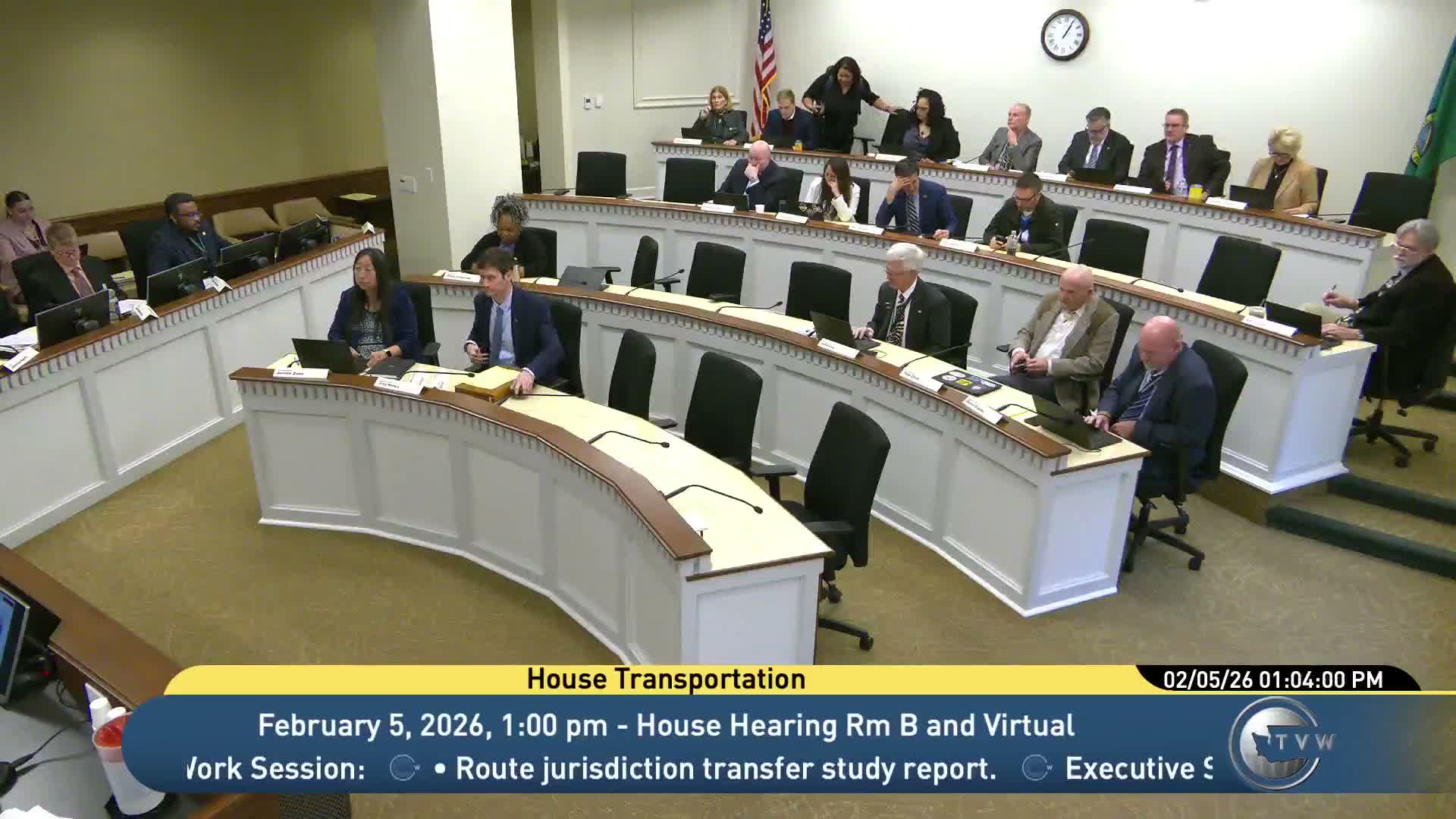
The Washington State House Transportation Committee on Feb. 5 heard a work session and public testimony tied to a Transportation Commission study of route jurisdiction transfers and a companion bill, House Bill 2,172.
Rima Griffith, executive director of the Washington State Transportation Commission, told the committee the commission reviewed ownership of centerline miles and found counties own roughly 49 percent, cities about 22 percent and the state roughly 9 percent. She said the RJT (route jurisdiction transfer) process is rare: the commission recorded 16 transfers since 1991 with a net change of about 10 miles from the state to local jurisdictions.
Paula Reeves, who led the study team, said the review found the state highway system remains largely appropriate in its current form and that wholesale realignment is not warranted. But the study recommended statutory updates to clarify the definition of state highways, adopt consistent criteria (connectivity, continuity and function), improve interagency coordination, and provide a transparent, data‑driven evaluation tool tied to the statute the commission uses to assess transfers.
Committee staff summarized HB 2,172 as a bill that would: treat abandonments of state highway segments longer than two miles (or those that include a bridge) as route transfers subject to the RJT process; require a pre‑request conference so parties assess eligibility early; expand required analysis to include costs, risks and impacts; and require the commissions report to include these considerations for the Legislature. Staff said the bill would take effect July 1, 2026.
Vice Chair and prime sponsor Representative Birnbaum told the committee the 2‑mile (or bridge) threshold is designed to surface transfers with significant cost or risk implications so the Legislature can consider appropriation or policy choices. He said a substitute is expected to include language allowing transfers to proceed without final legislative approval when both parties agree, and to send disputes to the Legislature.
Local governments and stakeholders who testified — including Tacoma Councilmember John Hynes and city staff — supported the bill for requiring more public input and clearer cost analyses. "These transfers can require budgetary and financial commitments," Hynes said, noting past Tacoma turnbacks that left the city managing major bridge investments. City attorneys and public works officials described cases where inadequate notice created planning and fiscal stress.
Commission staff and stakeholders repeatedly emphasized the distinction between the commissions RJT process (which culminates in a legislature‑codified list of state highways) and WSDOTs administrative abandonment authority. The commission recommended better record keeping and a bridge between the two processes so the Legislature, state agencies and local governments share a consistent inventory of changes.
The committee did not take final action on HB 2,172 on Feb. 5; it recessed to caucus and scheduled executive action on a separate agenda later in the day.