New Mexico committee tables memorial asking WQCC to hear petition on treated produced water
Loading...
Summary
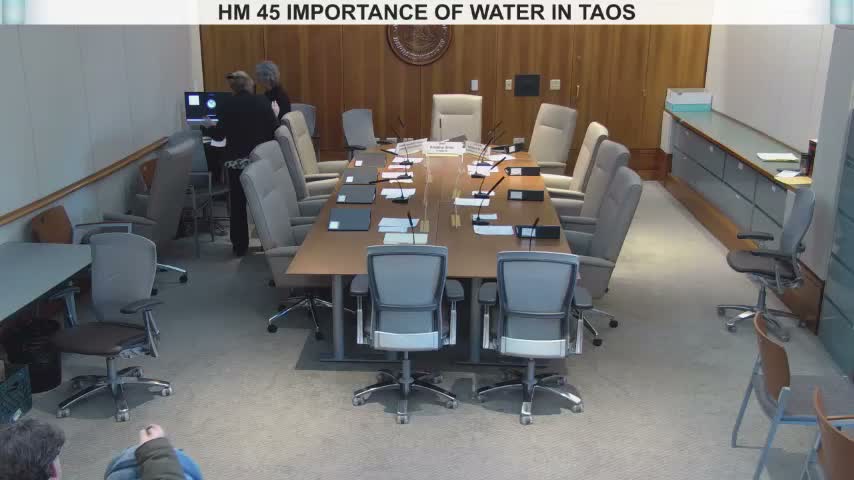
After hours of technical testimony and split public comment, the House Agriculture, Acequias and Water Resources Committee voted to table House Memorial 45, which sought to have the Water Quality Control Commission consider a petition on beneficial reuse of treated produced water.
The House Agriculture, Acequias and Water Resources Committee on Feb. 7 tabled House Memorial 45 after extensive testimony from scientists, acequia representatives, industry advocates and environmental groups.
Sponsor Representative Sanchez introduced the memorial as a nonbinding request that the Water Quality Control Commission (WQCC) set a timely hearing on a petition from Cuesta resident Luis Herrera. Sanchez said the petition aims to “consider the scientific evidence supporting the beneficial reuse of treated produced water” and argued that using treated produced water for industrial users could free scarce freshwater for farms and communities.
Zach Stoll, assistant director of the New Mexico Produced Water Research Consortium at New Mexico State University, testified in a technical capacity. “Our role is to generate the science-based information that helps decision makers understand what is technically feasible, what treatment would be required for different potential end uses, and what uncertainties remain,” Stoll said, describing toxicity and fit-for-purpose testing the consortium has used.
Public comment was sharply divided. Leslie Hillam, CEO of the New Mexico Chamber of Commerce, told the committee the memorial “recognizes the importance of water for the future of rural communities” and urged support. Petitioner Luis Herrera, speaking remotely, said the effort was meant to “bring science, transparency, and local benefit into the conversation” and to protect water rights for Northern New Mexico.
Opponents, including Sarah Canope of Amigos Bravos, Joseph Zupan (a Taos County registered environmental engineer), Tanis Fox of the Western Environmental Law Center, and representatives of conservation organizations, urged rejection. Canope said existing studies show produced water supplies are a small fraction of statewide needs and raised concerns about carbon footprint and remaining toxicity uncertainties. Fox cited the 18-month WQCC rulemaking in which New Mexico Environment Department (NMED) scientists testified there was insufficient evidence to authorize discharge of treated produced water at this time.
Several committee members, including Representative Zamora, argued the memorial’s petition had not been submitted to the WQCC and said they lacked the petition text to review. Zamora moved to table the memorial so members could examine the petition when it is formally filed; the motion carried and the chair announced the item was tabled.
The committee did not adopt policy language or change WQCC rules; the memorial was a nonbinding request. The sponsor and some witnesses said the memorial does not mandate reuse but asks the WQCC to “listen to the science” and consider the petition when it is submitted. The committee plans to reconvene on Saturday for additional hearings related to produced-water legislation, including House Bill 207.