Get Full Government Meeting Transcripts, Videos, & Alerts Forever!
Get email alerts on the Transportation topic
No spam. Unsubscribe anytime.
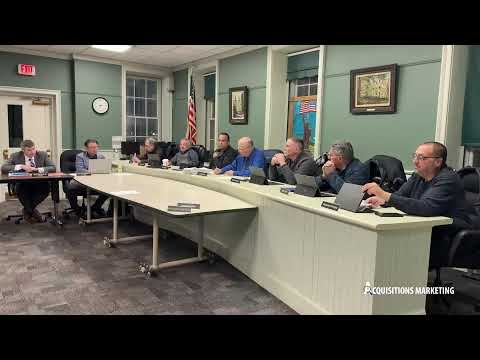
Goshen planning board conditions site plan for Muscat Court concrete plant, requires no‑left‑turn program and monitoring
Summary
Applicant for a Muscat Court ready‑mix concrete plant proposed a company‑enforced ban on inbound left turns from Route 17M, a $710,000 surety, and a 12‑month post‑occupancy traffic study; the board discussed enforceability, signage, and incident metrics before moving the application forward for Part 3 work.
The Goshen Planning Board reviewed a site‑plan for a ready‑mix concrete plant on Muscat Court and pressed the applicant to lock in traffic mitigations aimed at preventing left turns from Route 17M onto the private access road.
The board heard from John Lynch, director of operations for the applicant company, who said the firm had remediated the site at 9 Muscat Court and intends to operate an enclosed, insulated concrete plant. Lynch told the board the operation “can operate today with 0 restrictions” but that the applicant proposes to impose a company‑level restriction to eliminate inbound left turns by vehicles associated with the project.
Nick Tortorella, a licensed traffic engineer with Stonefield Engineering, summarized the conditions proposed in a letter submitted by the project attorney: a project‑only prohibition on inbound left turns from Route 17M onto Muscat Court for all trips generated by the facility; no on‑site retail sales to limit third‑party visitors; a fair‑share contribution to a town fund; posting of a surety bond in the value of about $710,000 (the letter cited a Kimley Horn estimate of $735,000 less roughly $25,000 in fair‑share contributions); and a post‑occupancy traffic‑monitoring study 12 months after opening to verify compliance and identify any crashes attributable to project trips.
Tortorella said the prohibition would be enforced by the operator’s own controls: “this program would be implemented for all trips generated by the [facility],” and the monitoring study would distinguish project‑generated traffic from background traffic so the town could judge whether the restriction was effective.
Board members raised practical enforcement questions. One member asked how the operator would control independent carriers and whether the company’s instructions alone would be sufficient; Lynch and the applicant’s counsel said contracted carriers would be managed through contractual terms and standard operating procedures. A separate concern was whether the town could require signage on the state right‑of‑way; Tortorella said the applicant is not proposing state‑right‑of‑way signage because the restriction is private and applies only to project trips, though the applicant offered to place directional signage on private property if feasible.
The board also discussed metrics that will trigger further action. Tortorella read the post‑occupancy review standards included in the applicant’s materials: observed trip generation compared with the approved traffic study baseline; compliance with the right‑turn ingress restriction for project trips; and any reported crashes at the Muscat Court/Route 17M location directly attributable to vehicles entering or exiting the project. The applicant agreed to post the surety bond 12 months after opening and to fund monitoring for a two‑year period.
Several board members noted the broader corridor safety issues at nearby Cannon Hill Road and said improvements there would be a separate DOT conversation. The applicant pointed to the project’s comparatively low trip generation—Tortorella cited a worst‑case study number of 35 trips in a peak hour and noted Institute of Transportation Engineers guidance that projects generating fewer than 50 peak‑hour trips typically do not noticeably change intersection operations.
The board did not take a final approval vote on the site plan at the meeting but instructed the applicant to supply Part 3 materials and to coordinate with the planning staff and town building inspector on silo height interpretations and any needed variances. The board also discussed available enforcement paths if the condition is violated (code enforcement citations to local justice court and, if necessary, injunctive relief in county Supreme Court).
The applicant’s presentation and the board’s questions are expected to be folded into the Part 3 submission and the formal conditions of approval the board will consider at a future meeting.