Get Full Government Meeting Transcripts, Videos, & Alerts Forever!
Get email alerts on the Public Access Tv topic
No spam. Unsubscribe anytime.
Greenbelt council meets with Greenbelt Access Television to review MOU, funding and programs
Summary
At a council work session, Greenbelt Access Television (GATE) outlined services, funding declines tied to cable-PEG fees, membership and youth programs; council and GATE discussed a memorandum of understanding, equipment lending and possible digitization grants.
Greenbelt '026 '026 '026
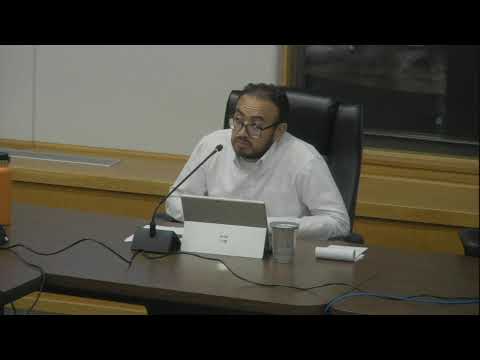
Mayor Emmett Jordan convened a Greenbelt City Council work session focused on Greenbelt Access Television (GATE), where the public-access nonprofit presented its history, operations and funding needs and council discussed a renewed memorandum of understanding and partnership steps.
GATE's president, Frank Trivassi, told council that the station was set up after federal cable-policy changes and that the outlet operates as a nonprofit serving public, education and government programming. "We're a nonprofit corporation," Trivassi said, tracing the organization's roots to the cable era and noting long ties to local civic leaders.
The board described GATE's revenue mix as PEG (public, education and government) franchise fees, memberships, classes and event income. Trivassi said PEG funding has declined alongside cable subscriptions, falling from more than $200,000 annually in earlier years to slightly north of $100,000 today. He added that the station supplements that revenue through classes, festivals and memberships.
Sheila, GATE's executive director, gave operational details: "Our hours are 11 to 7, Monday through Friday," she said, and explained how residents sign up for memberships, training classes and equipment checkout. GATE described classes (camera and editing instruction), a developing weekly editing workshop and a youth animation program that the board highlighted as county-unique and festival-successful.
Council and the GATE board reviewed a memorandum of understanding that formalizes prior production practices between the city and the station. Trivassi said the MOU codifies instances where GATE produces content the city may use and noted that GATE has paid approximately $6,000 per year in rent under the existing arrangement.
Board members and council also discussed outreach and services: GATE's animation and youth programs, a "learn to earn" internship that placed a high-school student on staff for the summer, and plans to expand school partnerships. The board reported that while direct cable-viewership metrics are limited, digital metrics (YouTube views and email-engagement rates) provide clearer audience indicators.
Residents and partner organizations praised GATE's role in the city. Doctor Rosado, representing the Greenbelt Black History and Culture Committee, thanked GATE and urged council to continue supporting the small staff: "Gate needs money, and I think they have their staff, as small as it is, has done a yeoman's job for this city."
Council and the board also discussed nonprogram topics that influence access and sustainability: equipment-lending policies (checkout requires membership and training; commercial rentals may be charged), the idea of a podcast room or pop-up sound booth, and the feasibility of digitizing archival recordings. Residents asked about old film and tape preservation; the board said it maintains DVDs, tapes and boxes that could be cataloged and digitized with grants or partner support.
GATE promoted upcoming public events, including the Utopia Film Festival (the board said the main festival is slated for Oct. 19—22), and invited the community to screenings and panels. Board leaders said they would pursue grant opportunities, closer coordination with city staff, and additional outreach to expand membership and internship pathways.
The session ended with council and GATE agreeing to continue the dialogue: staff will explore grant and partnership options, GATE will follow up on potential equipment- and facility improvements, and both sides said they would work toward clearer metrics and a sustainable funding pathway.