Get Full Government Meeting Transcripts, Videos, & Alerts Forever!
Get email alerts on the Rezoning Oak Grove Hill topic
No spam. Unsubscribe anytime.
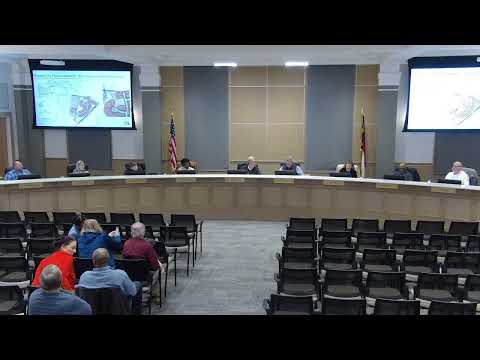
Planning Board recommends denial of Oak Grove Hill Phase 3 rezoning after residents warn of traffic, staff notes trade-offs
Summary
After extensive public comment about cut-through traffic and notice failures, the Huntersville Planning Board recommended denial of petition R25-12 to revise Oak Grove Hill Phase 3, citing concerns about reduced connectivity and neighborhood impacts despite applicant claims that cost and environmental mitigation drove plan changes.
The Huntersville Planning Board on Jan. 27 recommended denial of a developer request to revise the rezoning for Oak Grove Hill Phase 3, following public testimony about traffic impacts and extensive debate over connectivity, tree preservation and project economics.
Staff presented petition R25-12 and explained the proposed changes to the previously approved rezoning, including removal of the Carver Avenue connection into Phase 3, a small net increase of one unit to 157, identification of 83 specimen trees, and a canopy-save percentage of 13.76% (above the 10% minimum). Senior planner Lauren Speight said the applicant is requesting modifications to survey, canopy preservation and buffer rules and that staff used the same resident mailing list for hearing notices as the applicant. Speight noted the town received four returned notices and that postal receipt evidence was provided by the applicant.
Residents told the board they had not received required notice, would have attended earlier meetings if alerted, and warned that removing the road connection will push cut-through traffic onto Westminster Drive, Pembroke and other neighborhood streets. "It will come through Westminster Park, Pembroke, and Westminster Drive," resident Joe Sailors said, arguing the change will move traffic rather than reduce it. Other residents documented narrow streets, potholes and a lack of sidewalks, calling pedestrian safety a paramount concern.
Applicant Nate Bowman said construction costs and environmental mitigation drove the redesign. Bowman told the board that two earlier stream crossings triggered what he described as a mitigation fee from the U.S. Army Corps of Engineers and that eliminating one crossing reduced per-lot development costs (he cited figures dropping from about $232,000 per lot toward $195,000 per lot). Bowman said his traffic engineer concluded roughly 90% of peak-hour traffic would use the new primary connection and about 10% would route toward Pembroke and Westminster. "Without that connection and without Phase 3 being built, then the traffic has two outlets, Pembroke and Carver," Bowman said, adding he had shared bids and traffic analyses with neighborhood representatives.
Board members pressed staff and the applicant on three core issues: whether a new traffic impact assessment (TIA) was required (staff said the town engineering accepted the applicant's TIA determination of need and did not require an additional study for the reconfigured section); whether the Corps mitigation and bridge design constraints had been confirmed (the applicant said his team discussed options and provided documentation); and the risk that Phase 3 might never be built, leaving the neighborhood without the promised connection to Mount Holly Huntersville Road.
Members debated the policy trade-off between connectivity and feasibility. Some members said denying the revision would uphold the town's stated policy priority for connectivity and avoid setting a precedent that cost concerns excuse removing connections. Others said a denial might leave the property undeveloped for years and fail to deliver any connection. One member said, "we can't force the developer to put in the road he said he was going to put in for phases 1, 2 and 3," while another warned that approving the change would send the wrong signal about valuing connectivity.
An amendment that the board added would require a deed restriction protecting the heritage tree and incorporation of prior transportation notes from rezoning R22-05 into this rezoning if approved. Ultimately, the board adopted a substitute motion recommending denial of R25-12, citing inconsistency with the Huntersville 2040 community plan—particularly the policy on connectivity—and asked that the Town Board consider the neighborhood impacts raised in public comment. The transcript records that the motion "carries" and that the recommendation was denial; an explicit roll-call tally is not present in the provided record.
The Planning Board's recommendation is advisory; the Town Board will consider the rezoning at a subsequent meeting. The record shows also that staff is advising closer TIA phasing checks going forward and that staff and the applicant discussed deed-restriction language and mitigation documentation that could be reviewed if the developer revises the plan.
Next step: The Town Board will receive the Planning Board's recommendation and the packet of materials, including the staff report, the applicant's traffic analysis and any public comments submitted for the record. The planning board advised neighbors to file specific town public-works requests for pothole and sidewalk concerns through the Town Public Works request system.