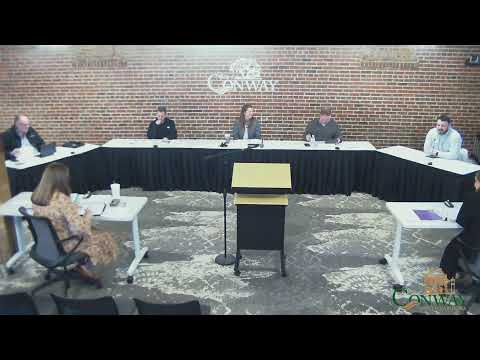
Conway planning commission defers broad UDO revisions, schedules workshop
Loading...
Summary
City planning staff presented extensive changes to the Unified Development Ordinance that would add supplemental standards and special-exception review for uses such as vape/tobacco shops, alternative financial services, gas stations and outdoor-event facilities; commissioners voted to combine amendment items and defer action pending a workshop.
City of Conway planning staff on Feb. 5 presented sweeping proposed changes to the Unified Development Ordinance that would add supplemental standards and special-exception review for several regulated commercial uses and rename portions of the code.
The staff presentation outlined amendments to articles 2, 4, 5 and 14 of the UDO, including coding changes to the use tables (conditional uses recoded to supplemental standards as 's'; accessory uses as 'a'; special exceptions as 'SC') and renaming Article 5 to better reflect supplemental use and development standards. "There were several instances where a use was listed as being permitted, but then listed in article 5 as a conditional use in the same zoning district," Speaker 5 said, summarizing why the changes were proposed.
A major focus was a new approach to outdoor event facilities. Staff described a new table of location-based standards that would allow the commission to set maximum events, event size, hours, amplified-sound limits, buffers and requirements for temporary structures or environmental protections. In some cases — for example, where a proposed service station or event is located within 200 feet of a residential property line or property zoned residential — the use would require a special exception. "If they are less than 200 feet away from a residential property line or from a property line that is zoned residential, they would have to ask for a special exception," Speaker 5 said.
Commissioners raised questions about how terms such as "small," "medium" and "large" event sizes would be defined and whether the new categories might unintentionally prevent large, planned facilities (an amphitheater was offered as a hypothetical). Speaker 1 noted that, if the code sets a medium maximum in a riverfront district, that could conflict with future large-scale event venues. Staff responded that the special-event permit process is typically sized-based and that staff could supply illustrative numbers, but it would be difficult to set minimums that fit all scenarios.
Rather than move the amendments forward immediately, the commission voted to combine the two related amendment items and defer them to the next meeting, directing staff to hold a workshop beforehand so commissioners can review the changes in greater detail. Speaker 5 said staff would prepare updated materials — including a color-coded chart identifying major and minor changes and pink highlights for recent edits — and that the earliest council first reading would be March 16 if the commission chose not to defer.
The deferral preserves time for more detailed review; staff also flagged that the amendments will be discussed at council's upcoming budget retreat and that some items (including the outdoor-event table and the removal of subsection 5.10.40 g) are recent edits.
The commission did not adopt the amendments on Feb. 5; the items were combined and deferred pending the workshop prior to the next regular meeting.