
Huntersville staff weigh rolling $154 solid-waste fee into property tax; spreadsheets show winners and losers
Get AI-powered insights, summaries, and transcripts
Sign Up Free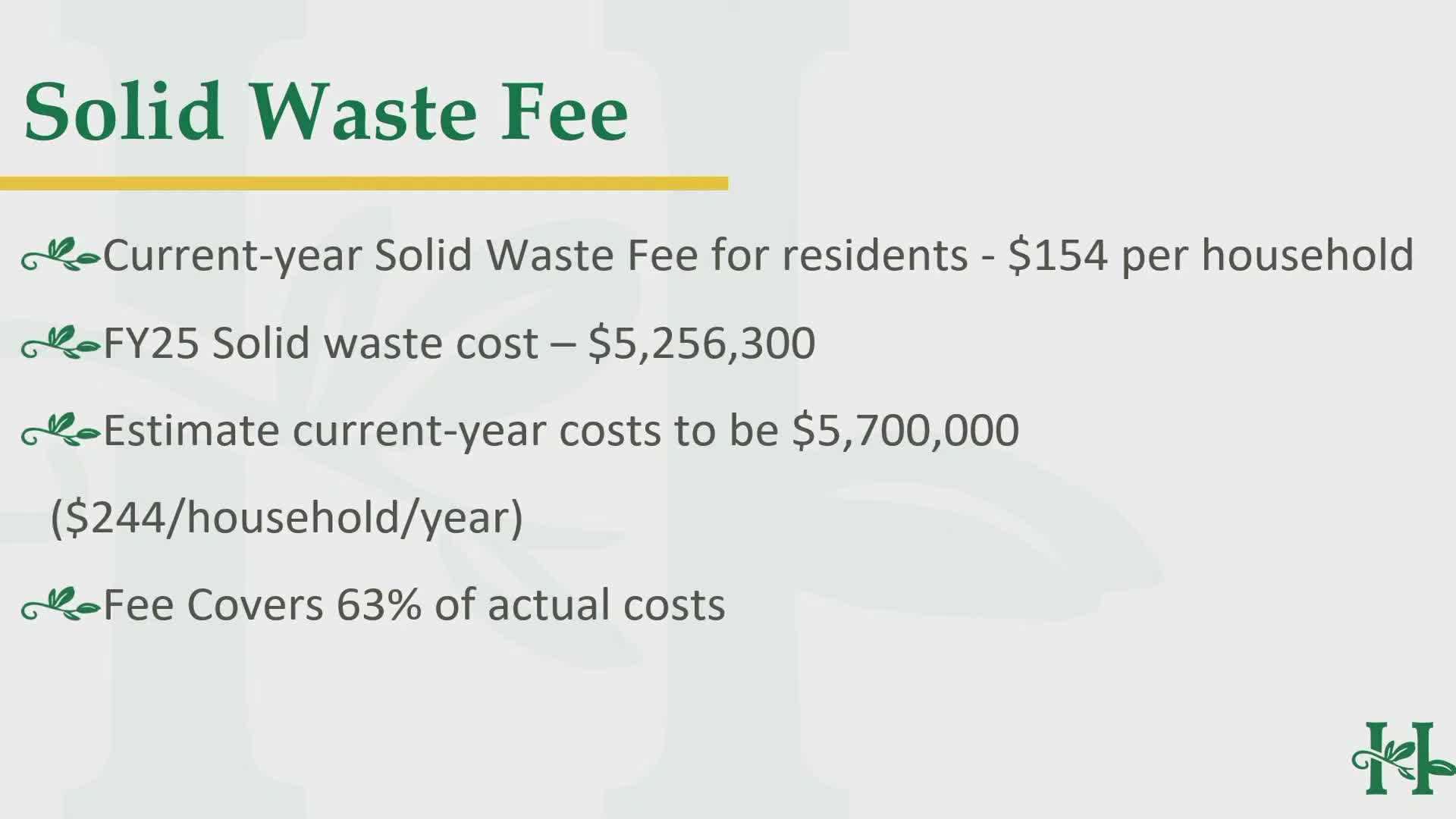
Summary
Huntersville staff presented options to either raise the $154-per-household solid-waste fee or roll it into the property tax. Staff said the current fee covers roughly 63% of collection costs and warned that conversion to the tax shifts costs between homeowners, businesses and vehicle owners; the board asked staff to return with formal budget options before the May/June budget vote.
Huntersville officials spent more than an hour on data and trade-offs on the town’s per-household solid-waste fee, with staff urging the board to decide how much of the program’s cost it wants to keep as a separate fee and how much to spread through the tax rate.
Staff said the current FY26 solid-waste fee is $154 per household and that the actual FY25 service cost equates to about $244 per household annually (roughly $20.37 per month). Jackie, who led the spreadsheet demonstration, said the fee currently covers roughly 63% of the town’s solid-waste costs and warned the board to be mindful of the budget implications of any decision. “If you choose to eliminate that solid waste fee, if you take $3,400,000 out of the general fund, replace it with something. Don’t increase that amount that you continue to rely on your fund balance to balance your budget,” Jackie said.
Staff presented two basic approaches.
- Keep a separate fee and raise it: board members were shown multi-year, audited figures demonstrating the fee has historically covered between roughly 41% and 71% of the service costs when the fee was lower; a fee sufficient to cover the full audited cost in staff models would be materially higher than $154. Patty and Jackie ran scenarios showing that full-cost recovery by fee alone would require a per-household charge materially larger than today’s rate.
- Roll the fee into the property tax: staff calculated that converting the $154 household fee into the tax base (using FY25 collections) is roughly equivalent to a 2.11¢ increase in the town tax rate (moving the current 22.75¢ toward about 24.86¢). That conversion lowers or eliminates the separate bill for many single-family homeowners at or below the median assessed value, but it also shifts the cost onto property-tax bills generally — including commercial property and vehicle property-tax assessments — meaning some taxpayers (notably many businesses and owners of higher-valued vehicles) would pay more while many homeowners would pay less. As Jackie summarized on the median-home scenario, “If you increase the taxes to take away that fee, then you will have saved almost $60” per year for a median-valued Huntersville home, but business parcels would see a corresponding tax increase.
Board members pressed staff on distributional fairness, long-term cost pressures (landfill tipping fees, CPI adjustments built into contracts) and the timing of any change. Jackie and Patty emphasized that folding the fee into the tax rate does not remove future cost pressure; tipping-fee or CPI rises would still push total cost higher in coming years. Staff recommended the board consider at minimum raising the separate fee to maintain the current percentage of cost recovery if the board is not prepared to roll it into the tax base.
Next steps: staff told the board they will present firm budget options and impact analyses during the upcoming budget process; the board will consider the change before the final budget adoption in June.