Get Full Government Meeting Transcripts, Videos, & Alerts Forever!
Get email alerts on the Tif Policy topic
No spam. Unsubscribe anytime.
Evanston committee begins citywide review of TIF districts, debates porting, payback and potential extensions
Summary
City staff briefed the Finance & Budget Committee on the status of Evanston’s TIF districts, explained how 'porting' between adjacent TIFs works under state law, and presented options — including payback rules, sunset, or legislative extensions for districts like West Evanston. Committee directed staff to return in March with specific recommendations.
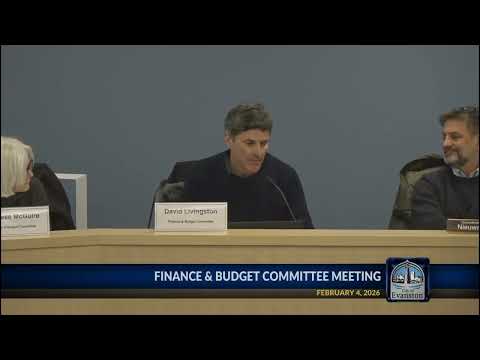
The Evanston Finance & Budget Committee spent the majority of its Feb. 4 meeting examining the city’s Tax Increment Financing (TIF) districts and a staff referral to establish clearer local policies on when to port money between districts, whether ported funds should be repaid, and criteria for extending or sunsetting TIFs.
Paul Zalmazak, the city’s Economic Development Manager, told the committee that TIF is a funding source governed by Illinois law and that the city council must approve TIF expenditures above $25,000. On porting, Zalmazak said state statute permits moving funds between adjacent TIF districts but only where boundaries touch, and he warned that multi‑step transfers that move money across the city would run against the law’s intent. "You can port between a boundary, but you can't transfer it from one on the north through one to one that's adjacent," he said, describing statutory limits.
Zalmazak gave concrete past examples to show how porting has been used. He said the city authorized a $650,000 grant for a business called Soul and Smoke by porting funds from West Evanston into the new 5 Fifths TIF to cover gap financing when the 5 Fifths district had no increment. That decision generated controversy about whether the receiving TIF should be required to reimburse the source TIF; staff said repayment terms were discussed at the time but are not consistently documented and should be clarified in policy.
The committee reviewed each TIF's status. Highlights included:
- Howard Ridge (TIF 5): staff reported a projected balance of about $2.2 million and recommended letting the district expire in 2028 after remaining projects and limited remaining debt are accounted for.
- West Evanston (TIF 6): staff reported a balance around $2.7 million but said planned projects (including a major Mason Park expansion and a potential property acquisition) will keep cash low for years. Because the district produced little increment for a decade after the financial crisis, staff proposed three paths: (1) let it retire in 2029; (2) bond or transfer funds to complete current projects; or (3) pursue a legislative extension (staff mentioned seeking a 12‑year extension) citing concentrated needs and environmental remediation costs.
- Dempster Dodge (TIF 7): originally established to stabilize a shopping center after the loss of an anchor, staff said $2.0 million was used to support development and that the TIF will primarily be used to service issued debt; staff recommended paydown and closure in 2027 if conditions allow.
- 5 Fifths (TIF 9): designed to slow displacement and support small business and housing‑repair grants, the 5 Fifths TIF is new and has limited funds; staff described ongoing development of an advisory committee, grant thresholds and a small business/housing assistance program.
Committee members raised trade‑offs: several urged clear rules on whether porting requires a repayment schedule or can be a permanent transfer, and others stressed that if a TIF is no longer serving its original purpose the city should consider sunsetting it so increment flows back to taxing districts (most notably schools). Council members also requested clearer, project‑level check‑ins during a TIF's life so decisions to continue or close a TIF are based on measurable milestones rather than end‑of‑life review.
Chair and staff agreed the discussion will continue: staff will synthesize member input and return in March with recommendations on each TIF’s disposition and with draft local policy language on porting, repayment expectations and criteria for extensions or closure.